The Ethics of Real Estate Contracting: Fair Play Between Promoters and Subcontractors

There is a particular kind of contract clause that every experienced subcontractor in this industry has learned to recognize on sight — payment terms that stretch to ninety or a hundred and twenty days, “pay when paid” language that quietly shifts the developer’s own collection risk onto a vendor with a fraction of its balance sheet, retention amounts that are difficult to recover even after work is satisfactorily completed, and dispute resolution clauses written in a way that makes litigation prohibitively expensive for anyone smaller than the party who drafted them. None of these clauses are, individually, illegal. And yet, taken together, they describe a pattern that is one of the most persistent, least discussed governance risks in real estate development: the systematic use of contractual leverage against smaller vendors, justified by the ordinary logic of commercial negotiation, until it eventually produces exactly the legal and reputational gridlock it was meant to avoid.
Why This Is a Governance Issue, Not Just a Commercial One
It would be easy to treat contracting terms with subcontractors as a purely commercial matter, properly left to procurement and legal teams negotiating within whatever leverage the market gives them. This framing misses something important. A developer’s relationship with its subcontractor base is a structural feature of how the entire project actually gets built, and the cumulative fairness or unfairness of that relationship shapes outcomes that eventually land squarely on the board’s desk — project delays, quality disputes, arbitration costs, and reputational exposure that a purely commercial lens tends to underweight.
A developer that consistently extracts maximum contractual advantage from its subcontractors is not simply winning individual negotiations. It is building a supplier base that is financially fragile, chronically under-resourced, and structurally incentivized to cut corners wherever the contract does not explicitly forbid it.
“Every major arbitration I’ve worked on involving a real estate developer and a subcontractor had the same shape. The developer had, technically, done nothing wrong under the contract. The contract itself was the problem, and everyone in the room knew it, including, eventually, the arbitrator.”
How Unfair Terms Create the Risks They Are Meant to Prevent
The logic behind aggressive contracting terms is usually defensive: extended payment terms preserve cash flow, pay-when-paid clauses transfer collection risk, and steep retention protects against defective work. What this logic consistently underweights is what happens to the subcontractor’s own operational capacity under the weight of these terms — and how that capacity, once eroded, feeds back into the developer’s own project risk.
A subcontractor operating on stretched payment terms is managing a permanent working capital shortfall, which translates directly into decisions on-site: fewer skilled workers retained between projects, delayed material procurement, reduced investment in quality control. None of this is a moral failing on the subcontractor’s part — it is a rational response to genuine financial constraint, and it produces exactly the quality and schedule problems the developer’s own project team will eventually have to manage, usually at greater cost than the cash flow advantage the original terms were designed to protect.
“We used to think we were negotiating hard and winning. What we were actually doing was slowly filtering out every subcontractor good enough to say no to our terms, and keeping only the ones desperate enough to say yes.”
Dispute Resolution Clauses and the Illusion of Protection
A particular category of unfairness deserves specific attention because it is often the least visible until a dispute actually arises: arbitration clauses drafted in ways that make formal recourse prohibitively expensive for a smaller vendor — arbitration seated in a distant city, panel fees exceeding a small subcontractor’s realistic claim value, or procedural requirements demanding legal representation they cannot afford.
These function as protection only in a narrow, short-term sense. Subcontractors who cannot pursue a legitimate claim do not simply accept the loss quietly — some walk away from unfinished work, creating exactly the operational disruption the developer least wants mid-project. Others pursue reputational campaigns or coordinated action with other affected vendors. And increasingly, given growing judicial attention to power imbalances in commercial contracts, clauses seen as designed to deny meaningful access to remedy have themselves become a source of legal vulnerability when challenged.
What Fair Contracting Actually Looks Like
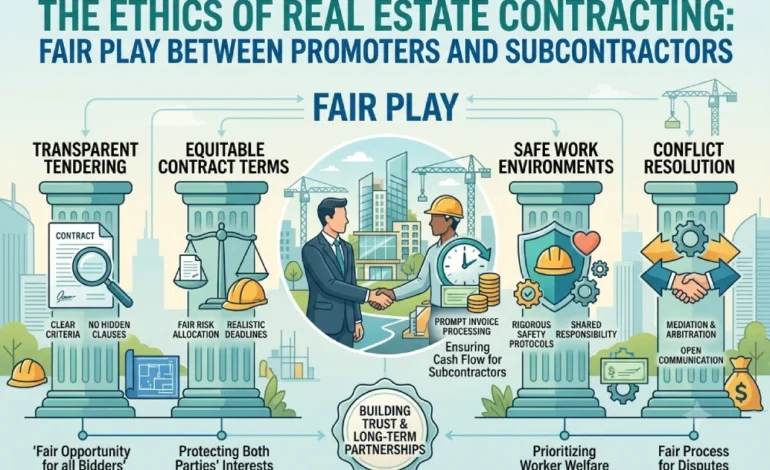
- Long payment terms, honored inconsistently
- Open-ended discretionary retention
- Dispute clauses inaccessible to small vendors
- Vendor pool shrinks to the desperate
- Realistic terms, paid on schedule
- Proportionate retention, clear release conditions
- Tiered, accessible dispute resolution
- Vendor pool retains genuine capability
None of this is an argument that developers should abandon commercial discipline or accept unfavorable terms out of generosity. Fair contracting is not the same as generous contracting. It is a recognition that a subcontractor relationship structured to be sustainable, rather than structured purely to maximize short-term leverage, produces better outcomes for the developer’s own project risk over time.
Payment terms that are realistic and consistently honored matter more than payment terms that are merely favorable on paper. Consistency and predictability, even at commercially reasonable rather than maximally aggressive terms, is what allows a subcontractor to plan, staff, and invest with confidence. Developers also benefit from treating vendor relationship management as a genuine strategic function — tracking payment timeliness, dispute frequency, and vendor retention rates as indicators of how sustainable their contracting practices actually are.
Why This Belongs on the Board’s Agenda
Boards of listed real estate and infrastructure companies routinely review project delivery performance, cost overruns, and litigation exposure. Few routinely review the fairness and sustainability of contracting practices with the subcontractor base as a distinct governance topic, even though the connection between the two is direct.
A board that periodically reviews vendor payment timeliness, subcontractor dispute volume, and patterns in vendor retention gains visibility into a risk category traditional project reporting often misses entirely. A rising pattern of subcontractor disputes, or a shrinking pool of repeat vendors willing to bid on new projects, is often a leading indicator of exactly the kind of quality and schedule problems that eventually surface as more visible governance issues.
A Closing Thought
The ethics of contracting between developers and subcontractors is sometimes framed as a matter of fairness for its own sake, and that framing is entirely legitimate. But it is also, distinctly, a matter of practical governance. A developer that treats its subcontractor base as a resource to be maximally squeezed is quietly building the conditions for the legal disputes, quality failures, and reputational damage that will eventually land, at significant cost, on its own project timelines and its own board’s agenda.
Fair contracting, in this light, is not a constraint on commercial discipline. It is a form of commercial discipline — one that recognizes a project’s ultimate success depends on the genuine capacity and goodwill of everyone actually building it, not only on the leverage a developer happens to hold at the moment a contract is signed.