Corporate Governance Lessons from Historic Project Overruns

Every construction professional I know carries a private list of mega-projects they study the way a surgeon studies a case gone wrong — not for entertainment, but because the failure teaches more than a hundred successes ever could. Over twenty-three years, mine has grown long. But three projects keep returning to my mind whenever I sit in a governance discussion today, because each of them makes the same argument in a different accent: mega-projects rarely fail on the construction site. They fail, first, in the room where oversight was supposed to happen.
This is a harder claim than it sounds. It is tempting, and comfortable, to explain overruns through the language of engineering — unforeseen ground conditions, design complexity, weather, inflation. All of these are real. None of them, on close inspection, are sufficient to explain overruns of the size that history has recorded. What actually explains them, again and again, is a governance failure at the top: a board or supervisory structure that either could not see the problem clearly, chose not to look, or lacked the technical standing to challenge what it was being told.
The Sydney Opera House — Governing a Design That Didn’t Exist Yet
The Sydney Opera House is the case every engineering student eventually hears about, and for good reason. Construction began in 1959 on a budget of roughly seven million dollars, with a four-year timeline. By completion in 1973, the cost had reached over one hundred million dollars.
What is less often discussed in the popular telling is the governance root of the failure. The winning design was selected from conceptual sketches, not a fully engineered set of drawings. Construction started before the structural and engineering challenges of that extraordinary roof form had been solved. In effect, the client authorized construction to begin on a building that had not yet been proven buildable — and the oversight structure around the project did not have the technical depth to recognize how dangerous that sequencing was.
Layered on top of this was political interference in technical decisions, culminating in the architect’s resignation partway through construction. Whatever one thinks of the artistic outcome — and the building is rightly celebrated today — the governance lesson is unambiguous: authorizing capital commitment on the strength of an unfinished design is a decision that belongs at the top of an organization, and it is precisely the kind of decision a technically informed board is meant to interrogate before signing off.
FIELD NOTE“Every mega-project disaster has a moment, usually very early, when someone senior enough to stop it decided not to ask the question. Sydney’s moment was the day they broke ground without a finished roof design.”
— a project controls specialist I once worked with
The Big Dig — When Oversight Itself Is Kept in the Dark
Boston’s Central Artery/Tunnel Project, better known as the Big Dig, offers a different and in some ways more troubling governance lesson. The project was originally estimated at under three billion dollars. By the time interest and related costs were fully accounted for, the number had grown past twenty billion.
Along the way, project leadership was found to have withheld information about a multi-billion-dollar cost overrun from the federal and state oversight bodies responsible for monitoring it — a revelation serious enough that it led to the resignation of the project’s top official.
This is a fundamentally different failure mode than Sydney’s. It is not a case of a board lacking the technical literacy to ask the right question. It is a case of management actively managing the information flow to governance, so that the right question could never be asked in time. The oversight structure that existed on paper was, for a period, effectively blind — not because it lacked capability, but because it was not being given the data its capability depended on.
FIELD NOTE“You can design the most rigorous oversight committee in the world. If the numbers you’re reviewing were massaged before they reached you, you’re not overseeing the project. You’re overseeing a story about the project.”
— a former state transportation official, on a conference panel
Berlin Brandenburg Airport — Politics Where Technical Judgment Should Have Sat
If Sydney is a story about starting too early and the Big Dig is a story about information withheld, Berlin Brandenburg Airport is a story about who was actually in the room making decisions. Originally budgeted at under three billion euros with a target opening in 2011, the airport did not open until October 2020 — nine years late.
What makes Berlin’s case so instructive for governance specifically is the composition of its supervisory structure. The project’s oversight board was populated largely by political appointees, with limited independent technical expertise at the table. Politically sensitive design changes were made and remade under political rather than engineering logic, and the airport’s smoke extraction system — central to its eventual regulatory failure — was designed around an unconventional approach that oversight lacked the technical grounding to properly scrutinize before it was built into the structure.
This is, in my view, the purest illustration of why ground-level technical experience belongs on the boards and supervisory structures of infrastructure projects. A governance body without genuine engineering literacy cannot meaningfully evaluate whether a life-safety system design is sound. It can only trust — and trust, unverified by technical judgment, is not oversight. It is hope wearing oversight’s clothes.
FIELD NOTE“The failure wasn’t any single bad decision. It was a structure where the people with the authority to decide didn’t have the training to know which questions mattered, and the people with the training to know had no authority to decide.”
— an engineer who consulted on the project’s recovery phase
The Common Thread Across All Three
Looking at these three cases side by side, a pattern emerges that I think is far more useful than any single case study on its own. Sydney shows what happens when a board authorizes construction on an unfinished technical foundation. The Big Dig shows what happens when management controls the information reaching an otherwise capable oversight body. Berlin shows what happens when the oversight body itself lacks the technical grounding to challenge decisions in the first place.
These are three different failure modes, but they share a single root cause: in each case, the gap between technical reality on the ground and what governance understood or was told about that reality was allowed to widen, unchecked, for years, before it became impossible to ignore. By the time each project’s true condition became undeniable, the cost of correction had multiplied many times over what early intervention would have required.
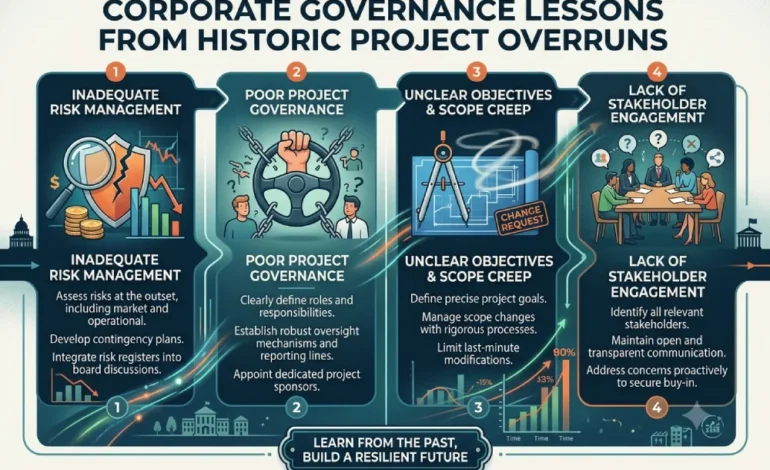
This is precisely why strong project governance requires three things operating together, not any one in isolation: technically literate people at the oversight level who can ask informed questions, an organizational culture that surfaces bad news honestly rather than managing it, and a governance structure with genuine authority to halt or redirect a project when the answers are unsatisfactory. Remove any one of the three, and history suggests the other two are not enough.
What Stronger Boardroom Oversight Actually Looks Like
None of this is abstract. Boards overseeing major infrastructure and real estate projects today can take specific, practical steps informed directly by these historical failures.
-
1
Validate buildability before authorizing capital. No major commitment should be approved on the strength of a design that has not been independently confirmed as buildable, not merely conceptually approved.
-
2
Insist on unfiltered, direct data access. Independent project audits, set at intervals the board controls rather than management, guard against the kind of information management the Big Dig suffered from.
-
3
Give technical voices real authority, not a symbolic seat. A single token engineer on an otherwise non-technical board, without power to slow a decision, reproduces Berlin’s failure in miniature.
-
4
Reward early bad news, not just good news. Every one of these three projects had people inside the organization who saw the trouble coming long before governance did.
A Personal Closing Thought
I have walked enough construction sites to know that every mega-project carries real, unavoidable uncertainty — geological, technical, and human. No board, however well constructed, can eliminate that uncertainty entirely, and I would be suspicious of anyone who claimed otherwise. But the three cases I have described here were not defeated by unavoidable uncertainty. They were defeated by governance structures that could not, or would not, see clearly what was already happening on the ground.
FIELD NOTE“History doesn’t remember these projects as engineering failures. It remembers them as failures of the people whose job was to ask, early and often, whether anyone had actually checked.”
— a retired infrastructure regulator, in conversation
That is the real lesson buried in these histories — not that mega-projects overrun because they are difficult, which they are, but that the difference between a difficult project and a disastrous one is almost always decided in the room where oversight either did its job or quietly declined to.