
How to Calculate Productivity At Construction Projects

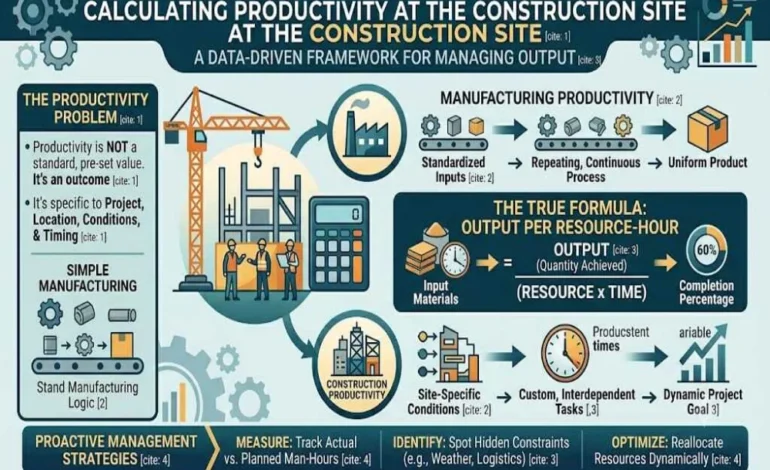
In the construction industry, productivity is the ultimate bridge between conceptual design and physical reality. Unlike standard manufacturing environments where specialized machinery and controlled assembly lines yield a predictable, uniform product under static conditions, construction sites are dynamic, chaotic, and highly susceptible to environmental variables.
On-site construction output represents a complex mix of specialized manual labor, fluctuating supply chains, unpredictable weather, and layered structural dependencies.
Productivity is not an inherent static metric or a baseline figure that can be copied from one project directly to another. Instead, it must be planned, monitored, measured, and continuously optimized based on the unique design criteria, geographical location, labor skill level, and execution timing of each specific asset.
To systematically manage this variability, project managers rely on established industry standard frameworks—such as those defined by the Project Management Institute (PMI) and the Chartered Institute of Building (CIOB)—to calculate, monitor, and improve labor output across key trades like concreting, shuttering, steel reinforcement, blockwork and plastering.
The Core Formula for Construction Productivity
At its most fundamental level, construction labor productivity is measured as the ratio of physical output achieved relative to the total labor resources and time expended to complete that work.
The universal baseline calculation used across industrial standards is:
\text{Labor Productivity} = \frac{\text{Total Output (Quantity Achieved)}}{\text{Labor Input (Number of Workers)} \times \text{Time Spent (Hours)}}
In practice, this is expressed as output per resource-hour or man-hour (e.g., cubic meters of concrete poured per man-hour, or square meters of shuttering erected per man-hour).
Alternatively, project controls often track the inverse of this metric, known as the Labor Activity Rate or Unit Rate:
\text{Unit Rate} = \frac{\text{Total Man-Hours Expended}}{\text{Total Quantity of Work Completed}}
Measuring productivity through unit rates allows project managers to see exactly how many hours of labor are required to complete a single unit of work, providing a clear basis for labor forecasting and cost estimating.
Setting the Baseline: Initial Planning and Thumb Rules
A successful construction project requires project managers to establish a robust baseline of planned productivity during the pre-construction phase. This begins by setting target labor parameters based on historical data and generalized industry norms.
While these baseline metrics vary between geographic regions and specific corporate standards, several common historical baseline benchmarks, or “thumb rules,” used during early project planning:
Steel Reinforcement (Bar Bending and Fixing)
- Standard Benchmark: One standard pair of workers—consisting of one skilled bar-bender (fitter) and one helper—is expected to cut, bend, and tie approximately 150 kg of reinforcement steel per standard shift.
Formwork / Shuttering Systems
- Standard Benchmark: A typical team of formwork carpenters and helpers is expected to erect and strike between 10 to 15 square meters (\text{m}^2) of conventional shuttering per day.
Concreting Operations
- Standard Benchmark: A standardized concrete placement crew (varying by setup, such as a concrete pump or boom placer) is budgeted to place a specific volume of concrete, measured in cubic meters (\text{m}^3), relative to the crew’s total shift hours.
| Construction Activity | Primary Unit of Measurement | General Industry Baseline Metric (Per Crew-Shift) |
| Steel Reinforcement | Kilograms (kg) or Metric Tons (MT) | ~150 kg per Fitter/Helper pair |
| Formwork / Shuttering | Square Meters (\text{m}^2) | 10 – 15 \text{m}^2 per carpentry crew |
| Concrete Placement | Cubic Meters (\text{m}^3) | Variable based on delivery method (Pump/Boom) |
| Brick / Blockwork | Square Meters (\text{m}^2) or Cubic Meters (\text{m}^3) | Variable based on block thickness and mortar type |
| Internal Plastering | Square Meters (\text{m}^2) | Variable based on single/double coat specification |
While these initial thumb rules provide a necessary starting point for developing early project schedules, relying on them as unchanging rules throughout a project is a flawed approach. Project managers must treat these numbers as a flexible baseline that must be adjusted to account for site-specific conditions.
Structural Nonlinearity: The Impact of Height and Stage
One of the most critical insights is the inherently non-linear nature of construction productivity. Labor efficiency is not a fixed variable; it changes significantly as a project moves through different phases and structural heights.
Substructure vs. Superstructure Efficiency
During substructure execution—such as pouring a large foundation raft or a massive basement slab—labor output looks deceptively high. A small crew can place hundreds of cubic meters (\text{m}^3) of concrete using a direct concrete pump or boom placer over continuous, wide-open surface areas. Material handling is straightforward, and structural complications are minimal.
However, as the building grows vertically (moving from the ground floor to the first, second, and subsequent typical upper levels), productivity naturally decreases. This vertical decline is driven by several unavoidable factors:
- Vertical Logistics and Material Handling: Crane hook time, concrete pumping pressure limits, and hoist lift capacities create severe bottlenecks. Workers spend more time moving materials vertically and horizontally through narrow spaces than doing actual installation work.
- Micro-Environments and Setup Fatigue: Formwork must be adapted to changing floor heights, safety scaffolding must be constantly re-erected, and crews work in more confined, exposed environments.
- Fatigue and Safety Protocols: Increased safety restrictions at greater heights change the pace of work, which naturally extends the unit rates for typical installation tasks.
Proactive Monitoring: The Multi-Floor Moving Average
Because productivity is non-linear and changes by project phase, evaluating performance using data from a single day or a single floor can lead to highly inaccurate forecasts. To overcome this data distortion, project controls professionals use a multi-floor moving average approach.
Instead of adjusting resource allocations based on a sudden dip on one floor, project managers collect actual expenditure data over two, three, or more consecutive levels. By calculating a multi-floor average, managers smooth out short-term operational variations caused by one-time issues like material delivery delays, minor equipment breakdowns, or bad weather.
This averaged baseline gives project managers a reliable view of real-world productivity, allowing them to make highly accurate projections for the remainder of the build.
Identifying Constraints and Standardizing Operations
When actual site productivity drops below the planned industry baseline, it indicates a bottleneck within the construction ecosystem. Low productivity is rarely caused by lazy workers alone; it is usually a symptom of deeper organizational or logistical failures.
Common root causes of low productivity include:
- Inadequate Workforce Training: Laborers lack the specific technical skills required for specialized modern systems, such as advanced aluminum system formwork.
- Poor Supervisory Direction: Supervisors fail to provide clear daily targets, causing, confusion and downtime.
- Unbalanced Labor Mix: An incorrect ratio of skilled masters to helpers leads to workflow bottlenecks on-site.
- Material and Tool Delays: Workers spend significant time waiting for tower cranes, searching for tools, or sorting materials due to poorly organized staging areas.
By tracking actual man-hours against physical progress daily, project managers can catch deviations early, step in to resolve operational issues, reallocate resources efficiently, and keep the project on track.
Conclusion
Calculating and managing productivity at a construction site requires a balance of historical industry benchmarks and dynamic, on-site adjustments. Because construction projects are highly variable, project managers cannot treat productivity as a fixed variable.
By using baseline thumb rules for early planning, tracking real-world non-linear changes across different heights, and using multi-floor moving averages, management teams can build a reliable, data-driven framework for their projects. Ultimately, measuring productivity accurately transforms performance tracking from a reactive accounting task into a proactive strategy for successful project delivery.