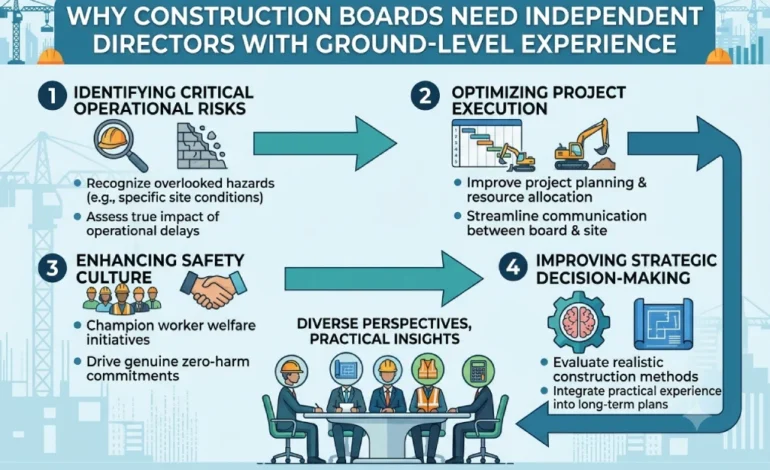
Why Construction Boards Need Independent Directors with Ground-Level Experience

I have spent the better part of my career standing in places most board members never visit. I have walked shuttering platforms forty metres above ground before the concrete was poured. I have stood in a foundation pit at 2 a.m. because the dewatering pumps failed during monsoon. I have watched a project director explain to a room full of financiers why a “minor geological variation” had just added eight months to a metro tunnel.
Twenty-three years of this has taught me one thing that no balance sheet ever will: infrastructure risk is not a spreadsheet risk. It is a ground risk, wrapped in a schedule risk, wrapped in a cost risk — and by the time it reaches the board, it has usually already happened.
This is why I have come to believe, quite firmly, that construction and infrastructure company boards cannot function safely or effectively without independent directors who have real, calloused, site-level experience. Not consultants who visited a project for a day. Not engineers who moved to head office fifteen years ago and never went back. People who have actually managed the chaos of a live construction site and understand, in their bones, how a project actually fails.
The Boardroom Is Built for a Different Kind of Risk
Most construction and infrastructure boards are populated, quite reasonably, with people who are excellent at what they do: chartered accountants, former bankers, legal experts, and seasoned finance directors. They read balance sheets fluently. They can spot a liquidity problem three quarters before it becomes a crisis. They understand covenants, capital structures, and investor sentiment better than most engineers ever will.
But here is the uncomfortable truth I have learned from two decades on sites: by the time a construction risk shows up in the financial statements, it is no longer a risk — it is already a loss. A landslide-prone slope that wasn’t stabilised properly. A subcontractor who was awarded a package based on the lowest bid rather than technical capability. A safety audit that was signed off without anyone actually walking the scaffolding. These are not financial events when they happen. They become financial events six, twelve, or eighteen months later, disguised as cost overruns, arbitration claims, or liquidated damages.
QUOTE“The board finds out about a landslide when it appears as a variance in the quarterly report. The site knew about it the day the borehole data came in.”
— a veteran project director I worked under
That gap — between when a risk is knowable and when it becomes visible to governance — is exactly what ground-level independent directors are meant to close.
Financial Expertise Cannot See What It Was Never Trained to See
I want to be careful here, because this is not an argument against financial expertise on boards. Infrastructure companies absolutely need directors who understand capital allocation, debt servicing, and investor relations. Construction is a capital-intensive, cash-flow-sensitive business, and poor financial governance has sunk more contractors than poor engineering ever has.
But financial expertise has a blind spot, and it is a large one: it cannot independently evaluate whether a project’s technical assumptions are sound. When a CFO looks at a project’s cost-to-complete estimate, they are trusting the numbers fed to them by the project team. When a purely financial board approves a bid for a new tunnel or a coastal highway, they are trusting management’s representation of geotechnical risk, contractor capability, and execution sequencing. There is no independent voice in the room asking the question that matters most on any construction project: “Has anyone actually walked this site and challenged these assumptions?”
I have sat in review meetings where a project’s schedule risk was presented as a single line — “2% contingency added for ground conditions” — and no one at the table, apart from me, knew enough to ask what that 2% was actually based on. Was it a real geotechnical investigation, or was it a template number copied from the last project? That distinction can be the difference between a profitable project and a company-threatening arbitration.
A board without technical depth is, in effect, auditing the outcome without ever being able to audit the process.
What Ground-Level Experience Actually Brings to a Board
When I say “ground-level experience,” I don’t mean a general engineering degree or a stint as a design consultant. I mean someone who has:
- Managed live construction sites through monsoons, strikes, material shortages, and safety incidents
- Sat across the table from contractors during dispute negotiations and understood which claims were genuine and which were opportunistic
- Overseen procurement decisions and seen firsthand how a “cheaper” subcontractor becomes an expensive mistake
- Walked a site during a safety audit and knows the difference between a compliant checklist and an actually safe workplace
- Been present when a project genuinely went wrong — not read about it afterward
This kind of experience gives a director an instinct that cannot be taught in a governance course. It allows them to ask the one question that unravels an overly optimistic project update: “What does the site engineer actually think, not what does the project report say?”
QUOTE“You can teach a good engineer to read a balance sheet in six months. You cannot teach a good accountant to smell a bad concrete pour in six years.”
— a retired executive director, during a board advisory session
That line has stayed with me because it captures something essential. Technical judgment built over decades on real sites is not a credential you can shortcut. It is earned through mistakes, near-misses, and the accumulated pattern recognition of having seen hundreds of projects go both right and wrong.
The Cost of Not Having This Voice at the Table
I have seen what happens when boards are entirely composed of financial and legal minds, however capable. Projects get approved on the strength of optimistic technical assumptions that no one on the board is equipped to challenge. Safety incidents are reviewed as compliance matters rather than systemic warning signs. Claims and disputes are managed as legal and commercial issues, when often the root cause was a technical decision made years earlier — a design change, a sequencing error, an underqualified subcontractor — that no one flagged at the time because no one in governance had the experience to recognise it.
Consider the pattern that repeats across the infrastructure sector, project after project: a tunnel boring machine gets stuck, a bridge girder launch is delayed, a dam’s foundation treatment takes longer than planned. In hindsight, these are almost always framed as “unforeseen ground conditions” or “force majeure.” But those of us who have spent our careers on sites know that a genuinely unforeseeable condition is rare. Far more often, the risk was foreseeable, but the pre-construction investigation was rushed, underfunded, or under-scrutinised — because no one senior enough in the organisation had the technical standing to insist on doing it properly.
A board with ground-level representation changes this dynamic. It creates a governance culture where technical rigor is expected, not assumed. It gives management a credible, senior voice to push back against internally when corners are being cut to protect a schedule or a bid price. And critically, it gives investors and lenders genuine confidence — not just in the numbers, but in the underlying execution capability of the business.
Independent Directors as a Bridge, Not a Watchdog
I want to be clear that this is not about turning independent directors into inspectors who show up at sites with checklists. That is not their role, and it is not what makes them valuable. Their value lies in translation and challenge — the ability to sit in a boardroom, listen to a project update, and ask the kind of pointed, experience-informed questions that a purely financial board simply would not know to ask.
QUOTE“What is the actual productivity rate on-site versus what is planned? Who signed off on this subcontractor’s technical capability, and what was that assessment based on? If this were your own site, would you be comfortable with this contingency number?”
— the kind of questions a technical director instinctively asks
These are not accusatory questions. They are the ordinary, professional questions that any experienced construction leader would ask instinctively — and their absence in a boardroom is precisely the governance gap that ground-level independent directors are meant to fill.
They also serve a second, quieter function: mentoring management teams on realistic risk communication. Young project managers and even seasoned commercial directors often present information upward in the language they think the board wants to hear — optimistic, tidy, resolved. A director who has been on the other side of that table, who has personally had to deliver bad news to a board, changes what gets said in the room. It becomes safer, and more expected, to say, “We have a problem, and here is what we are doing about it,” rather than waiting for the problem to become undeniable.
Building the Right Balance on the Board
None of this is an argument for technical directors to dominate boards or sideline financial governance — that would simply replace one blind spot with another. The strongest infrastructure boards I have seen are genuinely mixed: financial and legal expertise providing capital discipline and regulatory rigor, commercial expertise managing stakeholder and investor relationships, and technical, ground-level expertise providing an honest, experienced read on execution risk.
The goal is complementary scrutiny. A financial director asks whether a project is bankable. A technical director asks whether it is buildable, on the terms assumed. Both questions matter, and a board that can only ask one of them is only doing half its job.
When selecting independent directors for this role, companies should look beyond credentials on paper and ask harder questions: Has this person actually run a project through a genuine crisis? Have they made decisions with real consequences — not just advised on them? Do they still understand what today’s construction sites actually look like, or is their experience a decade or more out of date? Ground-level relevance matters as much as ground-level history.
A Personal Closing Thought
Twenty-three years in this industry has taught me that construction is fundamentally an exercise in managing uncertainty — geological, human, logistical, and financial, all at once. Boards exist to govern that uncertainty on behalf of shareholders, lenders, and the public who eventually use what gets built. A board that only understands the financial dimension of that uncertainty is, in effect, governing with one eye closed.
Independent directors with genuine ground-level experience are not a nice-to-have or a diversity checkbox for infrastructure boards. They are a structural necessity — the only credible mechanism by which a boardroom can ask the right questions before a risk becomes a headline, a claim, or a tragedy.
QUOTE“The site will always tell you the truth before the balance sheet does. The only question is whether anyone in the room is still listening to it.”
— something I tell younger engineers stepping into leadership roles
That is precisely the voice construction and infrastructure boards need in the room — and, in my experience, it is the one voice most consistently missing.