The True Essence of Bharat: Beyond the Surface of Public Criticism

A thoughtful response to the modern diaspora’s critique of India’s development and spiritual identity.
A few days back, I saw a video circulating on social media where a person of Indian origin, who was living in some foreign country, was talking some bad things about India. He was telling that how the systems in India are failed and even if someone gives him few crores of rupees, then also he will never return to India. In his passionate address to the camera, he went on a long tirade listing the various systemic breakdowns of his native land: the roads are poor, the taxation system is pathetic, and there are absolutely no proper drainage system facilities provided by the government. He claimed that these failures affect not only the poor but also the rich people too who pay much taxes.
Following the viral spread of this video, the comment sections across social platforms lit up. Many people were writing that he was right and that they would also do the same if they get a chance to go out of India. There seemed to be a wave of immediate validation for his grievances, a collective sigh from individuals who felt seen by his harsh words. However, while it is easy to get swept up in the emotional current of public venting, we must pause and evaluate the deeper implications of such public declarations.
The Boundary Between Personal Opinion and Public Devaluation
Actually, he was right in his observations of the visible issues. But this was his personal opinion, and a personal opinion cannot be a generic idea. If he tells this to his house, to his wife or children, it is okay. It is natural to discuss personal frustrations within the private confines of one’s household. But when he tells these things about a country (especially like India) in public, then he is wrong.
Publicly devaluing an entire nation under a broad brush of failure disregards the complexities inherent to global development and societal structures. First thing, if he is talking about India’s infrastructure and corruption, then he may not be knowing that corruption is everywhere in the world, whichever country he goes. No nation has completely eradicated greed or institutional friction; it merely changes its form and face depending on the hemisphere you reside in.
Furthermore, the physical realities of other parts of the world are far from perfect. There are places in foreign where the climatic conditions are unsafe to live and even the government can’t do anything to control. From catastrophic blizzards to scorching heatwaves, nature imposes its own severe limits. There are places where violence exists there in schools, and drugs in cities, etc. So if there are always pros and cons of every country, and exceptionally the place where a person lives, the narrative that safety and order are absolute in foreign lands is a mirage.
The False Comparison of Infrastructural Landscapes
A person living in a village in India, the way he is not having the same infrastructure facilities as in a city, same is true with other countries. There are even racism in many countries. To the point he made in public is wrong. It is fundamentally unfair to compare the hyper-developed urban centers of Western nations with the massive, agrarian, and rural landscapes of developing countries, expecting identical structural layouts overnight. Every country deals with internal disparities; structural imbalances exist across every continent, and no government possesses a magic wand to instantly level the playing field between its most remote outposts and its central economic hubs.
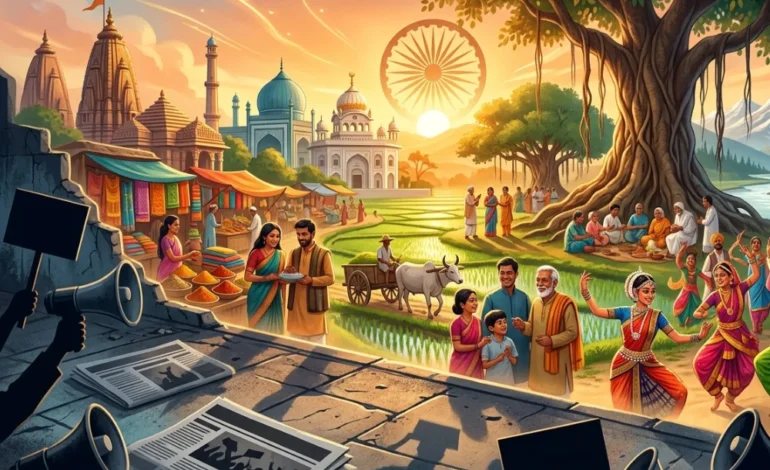
Second thing, he is talking about India, but did he really knows India, which is Bharat? Anyone since the person who was talking in the video does not know the real meaning of the term “Bharat.” Bharat is not just a geographical boundary defined by administrative lines or physical roadways; it is an ancient concept rooted in profound spiritual truth. The real meaning of “Bharat” is “Bha” + “Rata”—”Bha” means light, and “Rata” means seeking or attached to. Therefore, Bharat translates to the land of truth-seekers.
This land is the ashram of truth, populated by rishis who holy form of the world together the Vedas, Ramayan, and Mahabharat, and Bhagavad Gita. He might not even read Bhagavad Gita, and surely if only a person reads Bhagavad Gita, then only he knows himself and he starts loving Bharat. Without this baseline understanding of the country’s spiritual and intellectual heritage, any critique leveled against it remains entirely superficial, addressing only the outer shell while remaining completely blind to the living core inside.
The Cheap Metals and the Hidden Diamond
Now even if you are far from India and if you are seeking truth in your life, you are actually Bharatya. People actually forgot in the daily life the essence of spirituality, which is a base of India. They forget the hidden gem, a diamond which they have, in search of some cheap metals. In their rush to secure immediate material comforts, pristine roads, and highly structured urban environments, they trade away a priceless legacy for shiny, superficial alternatives. They don’t know the value because they don’t know the essence.
India has given the world the rich heritage of culture, yoga, truth, science, and many other things. One may argue that even these things are lost by modern Indians today, but still, it is prevailing in the earth. There are many foreigners who are adapting India culture and come here to stay in India. Every year, thousands of seekers travel from the West to the ashrams of Rishikesh, the temples of Varanasi, and the spiritual centers of the South, seeking the very peace that those born on this soil are discarding. Why these things are not complained?
Finally, I would love to say India is not just only about roads/infrastructure. It is a living, breathing civilization built on timeless principles that transcend physical inconveniences. While we must continuously work to improve our roads, our taxes, and our drainage systems, we must never allow our public discourse to degrade our national identity. True progress lies in developing our outer infrastructure while remaining firmly anchored in our inner spiritual wealth.