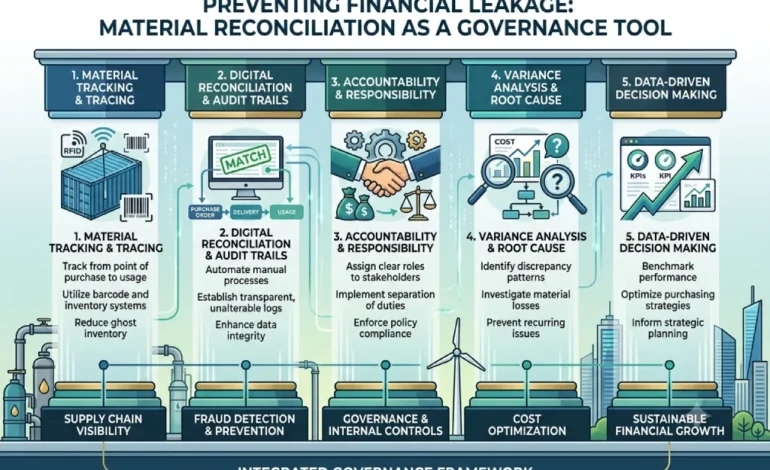
Preventing Financial Leakage: Material Reconciliation as a Governance Tool

Ask most boards where they expect financial fraud to originate in a construction company, and the answer usually points toward procurement, subcontractor billing, or executive-level related-party transactions. Few boards instinctively think about the site store — the shed where cement bags, steel reinforcement, aggregate, and a hundred other materials are received, stacked, issued, and consumed every single day. And yet the site store is one of the most consistent, quietly persistent sources of financial leakage in construction. It is also one of the most fixable, provided a board understands why material reconciliation deserves to be treated as a genuine governance tool rather than a routine back-office task.
Why Material Flow Is Such a Natural Leakage Point
Construction materials move through a uniquely exploitable pathway. Cement, steel, bricks, sand, and aggregate are purchased in bulk, delivered to often remote or loosely secured sites, recorded by store staff whose primary job is operational rather than financial, issued to work fronts based on requisitions frequently approved informally under time pressure, and eventually consumed into physical structures that are extremely difficult to audit after the fact. Once concrete is poured, nobody can reopen the slab to verify exactly how many bags of cement went into it.
This combination — bulk purchasing, decentralized handling, informal issuance, and irreversible consumption — creates conditions almost perfectly suited to leakage. Materials can be over-ordered and diverted for resale. Quantities can be under-recorded on receipt so a portion of a delivery is quietly sold elsewhere before it reaches the store ledger. Issue quantities can be inflated relative to what a work front actually required, with the surplus disappearing before it is ever billed. None of this requires sophisticated fraud. It requires only a gap between what physically happened on-site and what gets recorded on paper — and small gaps compound quickly into significant sums.
FROM THE AUDIT TRAIL“People assume construction fraud looks like a fake invoice for a consulting fee that never happened. Far more often, it looks like forty tonnes of steel that were correctly delivered, correctly signed for, and then quietly became thirty-five tonnes somewhere between the gate and the billing sheet.”
— a forensic auditor who has investigated multiple construction fraud cases
What Material Reconciliation Actually Means
Material reconciliation, at its core, is the disciplined practice of tracing every unit of material from three independent points and ensuring the figures match, consistently, over time.
Purchased & Delivered
Received & Issued at Store
Billed / Accounted Against BOQ
Where these figures don’t match, reconciliation is the process of finding out exactly why, rather than accepting a vague explanatory note and moving on. This sounds like a purely clerical exercise, and much of the mechanical work genuinely is. But its governance value lies precisely in what a persistent, unexplained mismatch reveals: not just a rounding error, but very often the visible edge of a much larger pattern of diversion, theft, or billing manipulation that would otherwise remain invisible above site level.
FROM THE AUDIT TRAIL“Almost every other financial control in a construction company involves people checking documents against other documents. Material reconciliation is one of the few controls where you’re checking documents against physical reality. That’s exactly why it’s uncomfortable, and exactly why it works.”
— an internal audit head at an infrastructure company
Why This Belongs on the Board’s Radar
It would be easy to conclude that material reconciliation is a site-level operational control, properly delegated to project accountants, with no particular need for board attention. This is precisely the assumption that allows leakage to persist undetected for years.
The scale involved is often larger than boards assume. On a major infrastructure project, materials frequently represent forty to sixty percent of total project cost. A leakage rate of even two or three percent on material spend, sustained quietly across a multi-year project, can represent a genuinely material sum relative to project margin — large enough to meaningfully affect reported profitability, yet small enough on any single transaction to escape scrutiny.
Reconciliation gaps are also an early warning signal for broader control weaknesses, not an isolated issue. And unresolved leakage does not stay contained to the site — it eventually surfaces as margin erosion explained away in board reporting through vaguer language: “cost overruns due to material price volatility,” “wastage higher than budgeted.” A board that does not ask pointed questions about reconciliation is, in effect, accepting these explanations at face value.
Building a Genuinely Auditable Link
The practical heart of this governance tool is ensuring a tight, auditable, difficult-to-manipulate link between store data and billing. Four structural features make this link robust rather than merely procedural:
Independence between the people who issue materials and the people who record and reconcile that issuance — otherwise the two “independent” data points are generated by the same hand.
Real-time recording rather than periodic batch entry, since movements logged weeks later from memory are far easier to manipulate or misremember.
A genuinely independent reconciliation function — someone outside the project team, ideally reporting through internal audit, periodically comparing store records against procurement and billing.
Low tolerance for unexplained variance, paired with genuine investigation. A culture that routinely writes off small discrepancies as “normal wastage” trains an organization to stop looking closely.
FROM THE AUDIT TRAIL“The first few months were uncomfortable. We found gaps we didn’t like the answers to. But within a year, the gaps got smaller, because everyone in the chain knew the numbers were actually going to be checked, not just filed.”
— a site commercial manager, on implementing stricter reconciliation
What Boards Should Ask
Boards do not need to involve themselves in store-level mechanics, but specific questions belong in periodic audit committee review: Is reconciliation performed by someone independent of the project’s own commercial team, and how frequently? What is the current material variance rate across major projects, and how has it trended? What happens, procedurally, when a variance is identified — genuine investigation, or a standard explanatory note accepted without challenge? And critically, does the board ever see raw variance data directly, or only a summarized, already-explained figure filtered through project management?
That last question matters most. A board that only sees material leakage after it has already been explained away by the people most affected by a genuine finding of fraud is not exercising real oversight — it is reviewing a story about the risk, shaped by the very function it is meant to be checking.
A Closing Thought
Financial leakage in construction rarely announces itself. It does not usually arrive as a single dramatic fraud that trips an obvious alarm. It accumulates quietly, a few percentage points at a time, in the gap between what a truck delivered, what a store ledger recorded, and what eventually appeared on a billing sheet — a gap that, left unexamined, can persist for years across dozens of projects without a single line item ever looking obviously wrong.
Material reconciliation, treated seriously and structurally rather than as a clerical formality, is one of the most effective and underused tools a board has for closing that gap. It requires independence between those who move materials and those who record that movement, discipline in checking that record against physical and financial reality, and a board willing to ask, consistently, whether the numbers it is being shown reflect what actually happened on-site or simply what the organization has learned to say happened.