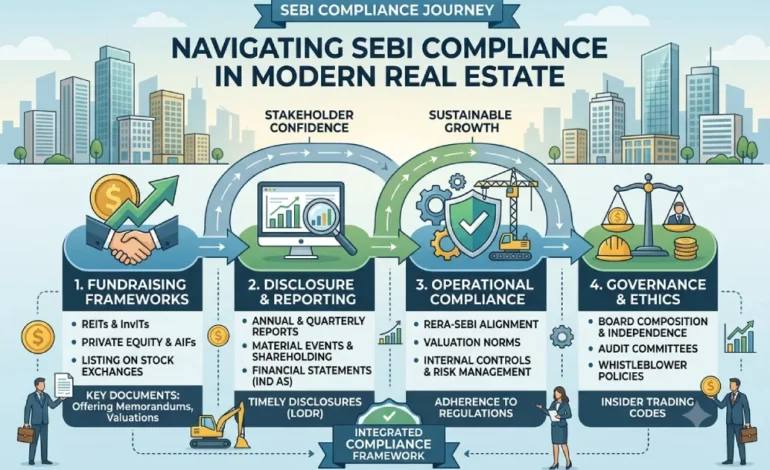
Navigating SEBI Compliance in Modern Real Estate

Somewhere in my second decade in this industry, I sat through a compliance training session where a young company secretary walked us through a new SEBI disclosure requirement using a slide titled “Checklist for Compliance.” I remember thinking, even then, that the word “checklist” was doing a lot of quiet damage. A checklist gets completed. A checklist gets filed. A checklist gets forgotten the moment the box is ticked. But regulation was never meant to be a checklist. It was meant to be a way of thinking.
Twenty-three years in construction, the last several spent watching how listed real estate and infrastructure companies actually behave in boardrooms, has taught me something most compliance officers already know but rarely say out loud: there is a world of difference between following the letter of a SEBI regulation and honouring its spirit — and in real estate, that difference eventually shows up on a construction site, in a delayed possession date, or in a disclosure that technically wasn’t false but was never quite true either.
This article is about why that distinction matters more in real estate than in almost any other listed sector, and why treating SEBI compliance as a tick-box exercise is one of the most expensive mistakes a construction company can make.
Why Real Estate Is a Special Case for SEBI
Most people think of SEBI regulations as a finance and legal matter — something that lives in the company secretary’s office, far from the site. I understand why. The regulations themselves are written in the dry, procedural language of disclosure timelines, material event thresholds, and related-party transaction norms.
But real estate and construction companies differ from most other listed businesses in one crucial way: our “product” takes years to build, changes shape constantly during construction, and is sold to customers — often ordinary families — years before it physically exists. A software company’s quarterly results reflect what has already happened. A real estate company’s quarterly results are, in large part, a set of promises about what will happen: possession dates, project completion percentages, cost-to-complete estimates, and revenue recognised against work that may or may not go as planned.
This is exactly why SEBI’s disclosure requirements exist — to ensure that promises made to investors and homebuyers are grounded in reality, not optimism. And it is exactly why a “letter of the law” approach fails so badly here. A company can disclose a project delay in perfectly compliant language, in the correct format, within the correct timeline, and still leave investors with a materially misleading picture — simply by choosing which facts to emphasise and which to bury in a footnote.
“You can be fully compliant and still be dishonest. The regulation tells you what to say. It doesn’t tell you how to say it, and it definitely doesn’t stop you from staying quiet about the thing that actually matters.”
— a project director, during a tense board review
The Tick-Box Trap
I have watched this trap catch even well-intentioned companies. It usually starts innocently. A project faces a genuine, unforeseen delay — a court stay on land use, a sudden change in a state RERA approval process, a geotechnical surprise that pushes back a foundation schedule by four months. The compliance team, working entirely within what the regulation technically requires, drafts a material event disclosure that is accurate but minimal. It states the fact of the delay without the context that would let an investor actually understand its severity.
Nobody in that chain of drafting is lying. Everybody involved could, in good conscience, say they followed the process. And yet the disclosure, taken as a whole, creates an impression gentler than reality — not because any single sentence is false, but because the framing was optimised for minimum disclosure rather than maximum clarity.
This is what I mean by the tick-box trap: compliance processes that are technically satisfied but substantively hollow. It happens because compliance is often treated as a downstream administrative function — something that happens after the real decisions are made on-site, rather than something that shapes how those decisions get communicated from the start.
I have sat in project reviews where the site team’s honest assessment was, “We are at least six months behind, and the cost-to-complete has moved significantly.” By the time that reality passed through commercial review, then legal review, then compliance drafting, it had softened into language about “revised timelines due to evolving market and regulatory conditions.” Every person along that chain would defend their own edit as reasonable. But the cumulative effect was a disclosure that no longer reflected what the site actually knew.
Why the Spirit of the Law Protects the Company Too
I want to push back gently on a common misconception here — that “spirit over letter” compliance is some kind of moral luxury, a nice ideal that costs a company money and competitive advantage. In my experience, it is almost always the opposite.
Real estate companies that treat disclosure as a genuine act of transparency, rather than a defensive legal exercise, build something a tick-box approach can never buy: credibility with regulators, investors, and homebuyers that compounds over time. A company with a track record of disclosing bad news early and clearly gets more benefit of the doubt during the next crisis. A company with a track record of minimal, technically-compliant disclosure has every subsequent statement read with suspicion — and rightly so.
“SEBI doesn’t punish companies for having problems. Every real estate company has problems — that’s the nature of the business. SEBI punishes companies for the gap between what they knew and what they said.”
— a senior independent director
That gap is precisely what the “spirit of the law” approach is designed to close. It asks a simple, uncomfortable question before every disclosure is finalised: if I were an investor reading only this document, would I understand the situation the way the project team actually understands it on-site? If the answer is no, the disclosure has failed, regardless of how many boxes were ticked to produce it.
Why the Spirit of the Law Protects the Company Too
Here is where my ground-level background becomes relevant to a conversation most people assume is purely a legal and finance matter. In my experience, the single biggest driver of tick-box compliance in real estate is not bad intent — it is distance. The people drafting SEBI disclosures are often several organisational layers removed from the people who actually know what is happening on-site. Information gets filtered, softened, and generalised at every layer, not out of malice, but because each layer is optimising for its own function: the site team for execution, the commercial team for customer relationships, the legal team for liability — and only at the very end does the compliance team receive a version of events already shaped by four other sets of incentives.
By the time a material fact reaches the person actually drafting the SEBI filing, it has often been rounded, softened, and stripped of the specific technical detail that would let a reader judge its real significance. This is not a legal drafting problem. It is a communication architecture problem — and exactly the kind of problem a board with genuine technical and site-level oversight is positioned to catch, long before it becomes a compliance issue.
“The best compliance officer I ever worked with wasn’t a lawyer. She used to walk the site once a quarter before drafting the board update. She said she couldn’t write an honest disclosure about a project she’d never seen.”
— a company secretary, on her own process
That instinct — to physically close the distance between where information is generated and where it is disclosed — is, I think, the single most practical thing a listed real estate company can do to move from letter-of-the-law to spirit-of-the-law compliance.
Regulatory Change Is Accelerating — And So Is the Cost of a Narrow Approach
It is also worth saying plainly: SEBI’s regulatory framework around real estate, related-party transactions, and material disclosures has been tightening steadily, and there is no reason to expect that trend to reverse. Listed real estate companies today operate under a level of disclosure scrutiny that would have been unthinkable when I started in this industry.
This is, in a very real sense, a competitive advantage disguised as a compliance philosophy. A construction company that treats every SEBI requirement as a floor rather than a ceiling — a starting point for honest communication rather than an endpoint to be satisfied — finds itself perpetually ahead of the regulatory curve rather than perpetually catching up to it.
What “Spirit-First” Compliance Actually Looks Like
None of this is an argument for vague, philosophical good intentions instead of rigorous process. Spirit-first compliance is, if anything, more disciplined than the tick-box alternative. In the companies I have seen do this well, it tends to include a few consistent practices:
-
✓
Project and site leadership are directly involved in reviewing material disclosures before they are finalised, not just consulted secondhand through intermediaries
-
✓
Disclosure language is tested against a simple standard: would a reasonably informed investor be surprised by the actual on-ground situation after reading this?
-
✓
Bad news is escalated and disclosed early and in proportion to its severity, rather than bundled into routine quarterly updates where its significance can be diluted
-
✓
Compliance teams are given enough technical literacy — and enough direct access to project teams — to ask informed questions rather than simply process what they are handed
-
✓
Boards actively probe the gap between what a disclosure says and what the underlying project data shows, rather than treating a signed-off filing as the end of the conversation
A Personal Closing Thought
I did not train as a lawyer or a compliance officer, and I do not pretend to understand every technical nuance of SEBI’s regulatory architecture the way a securities lawyer does. But twenty-three years of watching how information travels — or fails to travel — from a construction site to a boardroom to a public filing has taught me that compliance, at its core, is not a legal function. It is a communication function, and the law is simply the minimum standard by which that communication is judged.
A listed construction company that treats SEBI compliance as a checklist will always be vulnerable to the gap between what it knew and what it said — a gap that regulators, and eventually markets, are very good at finding. A company that treats compliance as an honest, continuous act of translation between the site and the shareholder will rarely find itself on the wrong side of that gap, because it was never trying to hide it in the first place.
“The law asks you what you must disclose. Your investors, your homebuyers, and your own conscience ask you what you should disclose.”
— something I tell younger colleagues stepping into project leadership
The companies that thrive over the long run are the ones that never let the first question replace the second.