Building a “Speak-Up” Culture on High-Rise Construction Sites

There is a particular kind of silence that settles over a construction site when something is wrong and everyone can feel it, but nobody says so out loud. I have stood in that silence more than once — at a concrete pour where the mix looked off to at least three people on the pour crew, at a scaffold inspection where a supervisor’s sign-off didn’t match what the workers actually building it knew about a missing tie, at a permit-to-work review where a young engineer clearly had a question he never asked. In every case, the information that could have prevented a problem already existed inside the organization. It simply never traveled from the person who had it to the person who could act on it.
This gap — between what a site actually knows and what gets said out loud — is one of the most underrated governance failures in the construction industry. A speak-up culture is not a soft, cultural nice-to-have sitting alongside governance. On a high-rise construction site, it is one of the core mechanisms through which governance actually functions.
Why High-Rise Sites Are a Particularly Demanding Test
Every construction site benefits from open communication, but high-rise projects concentrate the stakes in a way that makes silence especially dangerous. Work happens at height, often on tight schedules with multiple trades operating simultaneously on adjacent floors, frequently involving a layered chain of subcontractors and labor supplied through intermediaries rather than employed directly. A quality flaw in a structural connection on the fortieth floor is far harder to remediate later than the same flaw at ground level.
At the same time, the workforce structure common on high-rise sites often works against open communication. Labor is frequently contracted through multiple layers of subcontractors, which means a worker who spots a problem may not have a direct, trusted relationship with anyone who has the authority to act on it. Migrant or informally employed labor, common on many large sites, often carries a justified fear that raising a concern could affect their continued employment.
VOICE FROM SITE“Height makes every mistake more expensive, and our labor structure makes every voice quieter. Those two things happening at the same time on the same site should terrify any serious safety leader.”
— a site safety officer on a major high-rise project
Why Silence Is a Governance Failure, Not Just a Culture Problem
It is tempting to treat a lack of open reporting as a soft issue, separate from the harder mechanics of governance. This framing understates what is actually happening. When a worker or engineer who has identified a genuine flaw does not report it, the organization’s entire chain of inspection, sign-off, and oversight is operating on incomplete information, no matter how rigorous that chain looks on paper.
A checklist completed by someone afraid to note a genuine problem is not a functioning control. It is a document that looks like a functioning control, which is arguably worse, because it creates false confidence at exactly the levels of the organization — site management, project leadership, eventually the board — that are relying on that document to believe the risk has been properly managed.
What Makes Workers and Engineers Actually Stay Silent
Worker sees a flaw
FEAR OF RETALIATIONDirect supervisor
SAME PERSON, NO SAFE CHANNELProject leadership
SCHEDULE PRESSUREThe most common reason people stay silent is a justified fear of retaliation — formal, such as a contract not being renewed, or informal, such as quiet exclusion from future work. This fear is often strongest precisely among the workers whose observations matter most: those with the least job security and institutional protection.
A second reason is a simple belief that raising the issue won’t change anything. Workers who have previously flagged a concern and watched it disappear learn, reasonably, that speaking up carries risk without offsetting benefit — which teaches an entire workforce that the reporting system itself is theater.
A third, less discussed reason is hierarchical distance and language. Workers may not share a common language with site engineers, and may come from workplace cultures where questioning a supervisor is considered deeply inappropriate. A formal reporting channel that assumes fluent communication and cultural comfort with challenging authority will underperform on exactly the sites where it is needed most.
VOICE FROM SITE“We kept redesigning our reporting form. What we actually needed to redesign was the relationship between the person filling it out and the person who’d read it.”
— an engineer who moved from site execution into corporate safety leadership
What a Genuine Speak-Up Culture Actually Requires
-
1
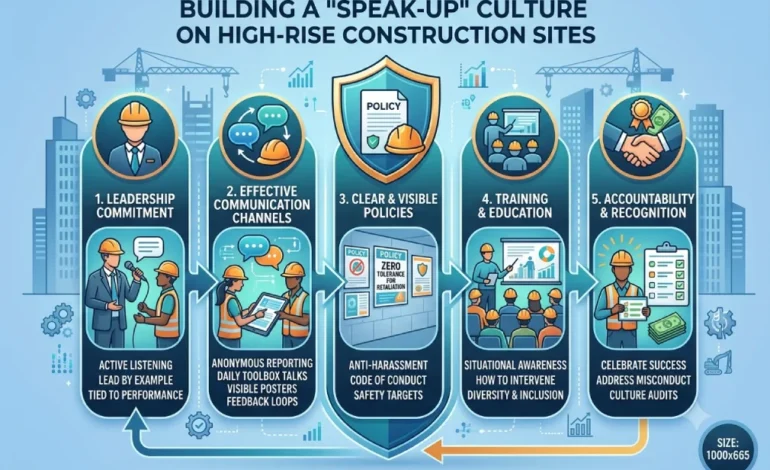
An independent reporting channel — a hotline, an independent site safety officer, or a third-party mechanism — so raising a concern doesn’t require confronting the person most likely to be affected by it.
-
2
Visible, consistent follow-through. Every reported concern needs a visible response, even a simple explanation of why it was assessed and not acted on.
-
3
Genuine anonymity and real anti-retaliation enforcement — not just a written policy, but visible consequences for any supervisor found to have retaliated.
-
4
Reduced language and hierarchy barriers — briefings in workers’ primary languages, safety representatives drawn from the workforce, and senior leadership actively soliciting concerns during site walk-arounds.
-
5
Genuine incentive alignment at leadership level — if site leadership is rewarded purely on schedule and cost, the unspoken message will always undercut the official reporting policy.
The Board’s Role in Making This Real
Worker raises concern
INDEPENDENT CHANNELVisible action & response
TRACKED, NOT FILED AWAYBoard reviews trend
AS A GOVERNANCE METRICNone of this happens by accident at site level, and none of it survives without genuine attention from governance above the project. A board that reviews rising reporting volume as a positive indicator of a healthy culture sends a fundamentally different signal than one that treats it as evidence of a site under-performing. Boards benefit from periodically reviewing not just safety incident data, but reporting volume trends, response times, and any patterns of retaliation complaints — treating these as genuine governance metrics rather than a subset of HR reporting.
A Closing Thought
The silence described at the start of this article is rarely a mystery to the people standing inside it. Workers and engineers on a high-rise site almost always know when something is wrong before it becomes a headline. The genuine governance question is not whether that knowledge exists somewhere in the organization — it almost always does — but whether the organization has built a structure where that knowledge can travel safely, quickly, and without personal cost to the person who holds it.
A transparent workplace culture where labor and engineers can raise a genuine concern without fear is one of the most direct, practical mechanisms by which governance actually reaches the ground it is meant to protect. Build it deliberately, and a great deal of a site’s safety and quality performance becomes far easier to sustain. Neglect it, and even the most elaborate governance structure is, in the end, only as reliable as the silence it never noticed.