The Architecture of Expectations: Bridging the Gap Between Compliance and Value Creation

Managing client expectations is one of the most persistent and delicate challenges in project management, consulting, and service delivery. A frequent tension arises when a client demands constant innovation, transformation, or sudden “novelty,” while the structural integrity of the project relies on steady, rhythmic, and baseline compliance.
As articulated in the personal narrative from the audio recording, a professional tasked with standard safety and quality inspections over an extended period encountered an unexpected inquiry from a long-term client. Despite over a year of consistent delivery based on agreed-upon parameters, the client asked, “Have you seen anything new? Have you implemented any novel changes?”
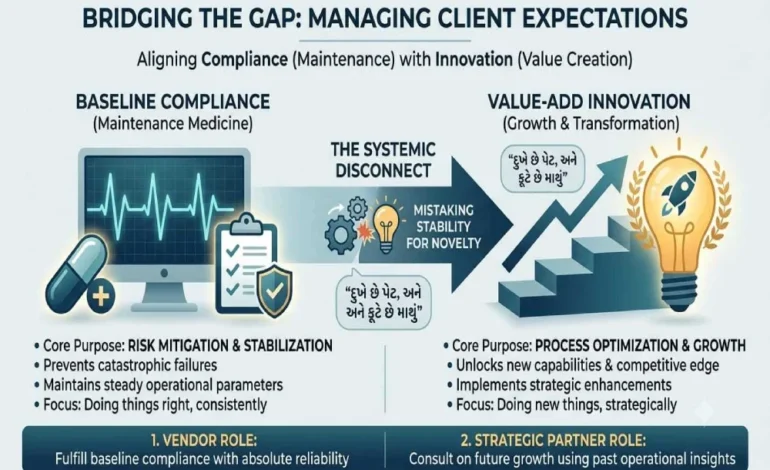
This scenario perfectly illustrates a common systemic disconnect: the client conflating routine operational stabilization with disruptive change, failing to realize that some of the most critical processes are designed entirely to prevent change.
The Medical Analogy: Stabilization vs. Evolution
To explain this dynamic to the client, the speaker in the audio utilized a brilliant medical analogy. Routine quality assurance, safety checkpoints, and adherence to predetermined parameters function exactly like daily maintenance medications for chronic conditions like hypertension or diabetes.
- The Purpose of Maintenance: A patient takes blood pressure medication every single day to maintain a steady baseline, prevent catastrophic spikes, and stay healthy.
- The Misconception of Outcomes: It would be highly flawed for a patient to look at their doctor after a year of steady blood pressure and say, “I’ve been taking this pill for a year, but I haven’t lost weight, my skin isn’t glowing, and I don’t feel a surge of new energy.” The medication was never engineered to cause weight loss or physical transformation; its sole, vital purpose was stabilization.
In project environments, structural safety checks, compliance frameworks, and strict quality gates are the “maintenance medicine” of the enterprise. They exist to ensure that nothing goes wrong, that parameters remain within specified boundaries, and that risk is minimized. Demanding sudden novelty from a process designed strictly for risk mitigation is an analytical misalignment.
“Dukhe Chhe Pet, Ane Kute Chhe Mathu”
The audio accurately captures this phenomenon with a classic Gujarati proverb:
“દુખે છે પેટ, અને કૂટે છે માથું” (The stomach aches, but the head is beaten.)
This idiom describes a situation where the actual problem lies in one area, but the reaction, complaints, or remedies are misdirected entirely toward another.
When clients feel a vague sense of stagnation, competitive pressure, or market anxiety, they often project those feelings onto their existing service providers. They might demand “something new” or express dissatisfaction with a perfectly functioning compliance framework, simply because they are looking for growth or innovation elsewhere and do not know how to articulate it. They attack the “head” (the steady quality inspector) when the true “stomach ache” is a broader corporate need for strategic evolution or business transformation.
The Paradigm Shift: From Vendor to Strategic Partner
While it is easy to dismiss erratic client demands by relying on the old adage that “the client is always right” (or as the audio notes, “Client is God”), modern corporate environments demand a more sophisticated approach. The landscape of service delivery has fundamentally shifted from a model of pure compliance to one of holistic value addition.
| Traditional Compliance Model | Modern Value-Add Partner Model |
| Focuses strictly on stipulated parameters. | Observes baseline parameters while seeking optimizations. |
| Acts as a passive auditor or inspector. | Acts as a proactive risk mitigator and advisor. |
| Goal: Avoid failure and penalties. | Goal: Ensure stability while unlocking operational insights. |
| Communication is transactional and reactive. | Communication is strategic, educational, and consultative. |
Today’s corporate world increasingly requires service providers to wear two hats simultaneously. You must flawlessly execute the repetitive, protective tasks that keep the business safe (the baseline compliance), while actively documenting data trends to offer consultative insights (the value-add).
Strategies for Aligning and Educating the Client
To manage these shifting expectations without compromising the foundational parameters of a project, professionals must implement proactive communication frameworks:
Separate “Run” from “Transform”
Establish clear boundaries during project onboarding. Ensure the client understands which workflows are dedicated to maintaining the baseline (“Running” the business safely) and which allocations, if any, are dedicated to experimentation and improvement (“Transforming” the business).
Visually Demonstrate the “Invisible Negative”
The hardest part of a compliance or safety role is that when you do your job perfectly, nothing happens. Providers must find ways to make the absence of failures visible. Regular reporting should highlight the number of anomalies prevented, risks averted, and standard deviations caught. Showing the disasters that didn’t happen validates the steady-state framework.
Translate Data into Consultative Insights
If you have been conducting inspections for over a year, you sit on a goldmine of data. Even if the parameters haven’t changed, the frequency or patterns of near-misses might show trends. Presenting these trends to the client satisfies their hunger for “something new” by providing them with strategic foresight rather than disrupting a stable process.
Conclusion
Managing client expectations requires a delicate balance of empathy, education, and strategic positioning. When a client undergoes the cognitive dissonance of wanting innovation from a stabilization process, it is the provider’s responsibility to gently guide them back to the core objectives using clear analogies. By respecting the vital role of baseline compliance while stepping up as a proactive business partner, professionals can transform awkward client confrontations into powerful opportunities for deeper collaboration.