
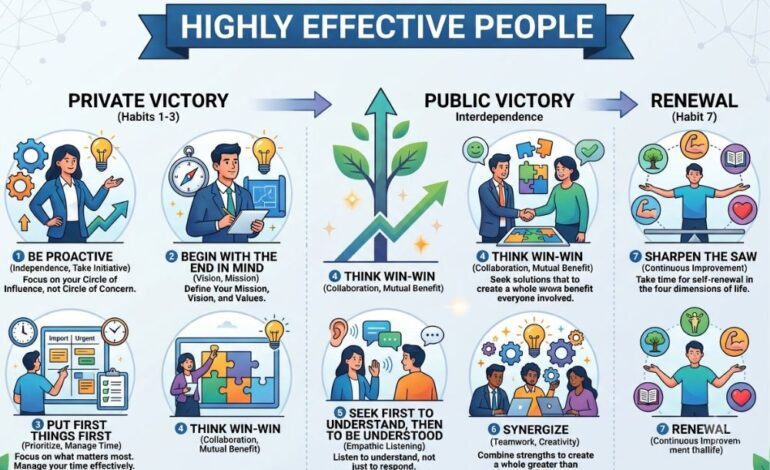
7 Habits Of Highly Effective People.

The Internal Compass: Why “The 7 Habits of Highly Effective People” is the “Ginger Tea” of Personal Growth
In the vast landscape of self-improvement literature, there are thousands of titles that come and go like seasonal trends. However, a few rare gems stand the test of time, becoming “evergreen” guides for generations. Stephen R. Covey’s The 7 Habits of Highly Effective People is undoubtedly one of the greatest books I have ever read. Despite being published decades ago, its principles remain as relevant today as they were on the day they were written.
This isn’t a book written in a weekend to catch a trend. The writer analyzed his life and the lives of the most successful people in history, synthesizing many years of experience into a cohesive framework. It is a masterpiece of structure, wisdom, and practical application.
The Healing Power of the “Ginger Tea” Effect
To describe the experience of reading this book, I often use a very specific metaphor: It feels like a cup of Indian ginger tea (Adrak Wali Chai).
In India, ginger tea is famous not just for its comforting taste, but for its medicinal and healing properties. When you take that first sip, you don’t just feel freshness; you feel a deep sense that the content is healing your throat and your body. The ginger provides a “kick” that wakes up the senses and clears the congestion of the mind.
Reading Covey’s work is remarkably similar. It isn’t just “flavorful” fluff. It is “healing” literature. The principles act like the ginger—they sting a little at first because they challenge your deep-seated excuses, but ultimately, they heal your approach to life. Blended with the “masala” of the Paradigm Shift, the book forces you to change the lens through which you see the world. It shifts you from a “victim” mindset to a “creator” mindset, providing a mental clarity that feels as restorative as a hot cup of tea on a rainy afternoon.
A Sequenced Journey: The Roadmap to Maturity
One of the most impressive aspects of this book is its architecture. All the habits mentioned are sequenced in a proper manner based on priority. They aren’t just a random list of “good ideas”; they are a roadmap for human development.
Covey divides the habits into two major phases:
- The Private Victory (Independence): Habits 1, 2, and 3 focus on self-mastery.
- Be Proactive: Taking responsibility for your life.
- Begin with the End in Mind: Defining your mission and goals.
- Put First Things First: Prioritizing what truly matters.
- The Public Victory (Interdependence): Habits 4, 5, and 6 focus on how we interact with the world.
- Think Win-Win: Seeking mutual benefit.
- Seek First to Understand, Then to be Understood: The foundation of empathetic communication.
- Synergize: Creating something greater than the sum of its parts through teamwork.
Finally, Habit 7 (Sharpen the Saw) is the habit of renewal that keeps the others functioning. Whether you take “Be Proactive” or “Seek First to Understand,” every single habit is structured exceptionally well and illustrated with life examples that make the complex feel incredibly simple.
The Core Concept: The Principle-Centered Approach
At the very heart of the book lies the concept of being Principle-Centered. Most people are “centered” on external things: they are spouse-centered, money-centered, work-centered, or pleasure-centered. The problem with these centers is that they are volatile. If your “center” is your job and you lose that job, your entire world collapses.
Covey suggests that we must be centered internally—anchored by “unchanging principles” like integrity, service, and growth. This allows a person to remain stable in any phase of life.
The Example of Lord Ram: The Ultimate Principle-Centered Life
To understand this concept through an Indian lens, we look at Lord Ram. Throughout his life, Lord Ram faced what many would consider a “disastrous” series of events. On the day of his coronation, he was exiled to the forest for 14 years. He lost his kingdom, his father, and eventually had his wife abducted.
Yet, Lord Ram remained centered. His internal compass—his Dharma—never wavered. He stayed focused and composed despite the external chaos because he was anchored in principles rather than circumstances. This is exactly what Covey is teaching. When you are principle-centered, you possess an internal “Mariyada” (boundary/discipline) that keeps you from being swept away by the storms of life.
Why the Principles are Evergreen
Because the book is based on “character ethics” rather than “personality ethics,” it does not age. While other books teach you how to “look” successful or how to “manipulate” people into liking you, the 7 Habits teach you how to be a person of value.
It is a handbook for life that you can return to time and time again. Each time you read it, you find a new “ginger” kick that addresses a new problem you are facing. It is structured so that you can apply it to your family life, your professional career, and your own internal peace of mind.
Final Thoughts
If you are feeling overwhelmed by the complexity of modern life, stop looking for quick fixes. Go back to the basics. Pick up this “old” book and let the principles heal your perspective. Drink the “ginger tea” of Stephen Covey’s wisdom, find your internal center, and start building a life of effectiveness from the inside out.