From Operations to the Boardroom: A Leadership Transition Guide for Engineers

I still remember the first board meeting I sat in as a director rather than as the engineer presenting to the board. For twenty years, I had been the person walking into that room with a project update, a set of drawings, and a defensive posture, ready to explain why a foundation had taken longer than planned. Now I was on the other side of the table, and within the first ten minutes I realized something uncomfortable: the skills that had made me an excellent chief engineer were not, by themselves, going to make me a good director. I knew how to solve problems. I did not yet know how to govern.
That gap took me the better part of two years to close properly, and I have since watched dozens of talented engineering and quality leaders struggle with the same transition. This article is my attempt to write down what I wish someone had told me at the start of that journey.
Why This Transition Is Harder Than It Looks
On paper, moving a senior engineer or quality leader onto a board looks like a natural promotion. Who better to govern an infrastructure company than someone who has spent decades actually building infrastructure? And there is real truth in that instinct — technical credibility earned on real sites is genuinely valuable at board level.
But the skills of operational leadership and the skills of governance are not the same skills wearing different clothes. They are genuinely different disciplines, and the transition fails more often than it should because people assume the first will automatically produce the second.
MENTOR NOTE“In operations, your job is to solve the problem in front of you. In the boardroom, your job is to make sure the right problem is in front of you in the first place.”
— a colleague who made the same transition
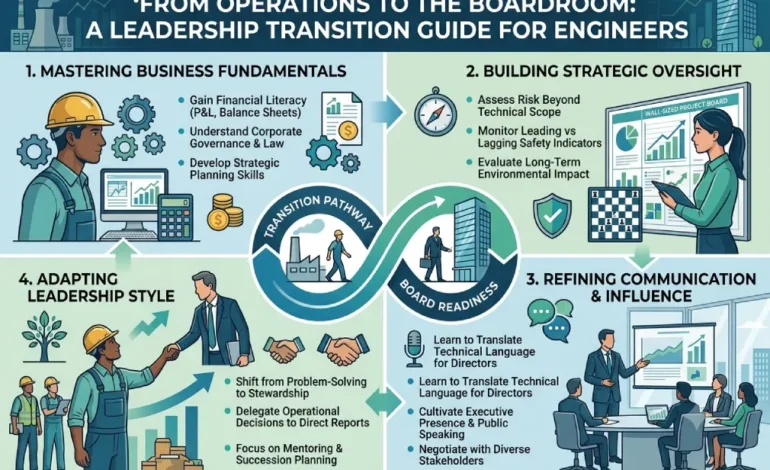
An engineer’s instinct, honed over a career, is to dive into the technical detail — to ask for the borehole data, the productivity numbers, the root cause of a defect. A director’s job is different: to ensure the organization has the right systems in place to catch that problem before it reaches the board, and that management is being appropriately challenged and supported in fixing it. Learning to let go of the instinct to personally solve the problem, and instead build the muscle of strategic oversight, is the hardest adjustment most engineers make.
From Problem-Solver to Question-Asker
The most practical shift I can describe is this: an operational leader is trained to arrive at answers. A director is trained to arrive at the right questions.
When I was a project head, my value was measured by how quickly and correctly I could resolve an issue. That instinct nearly sabotaged me in my first year as a director, because I kept trying to solve problems that were not mine to solve — I would catch myself mentally redesigning a slab detail during a board presentation instead of asking whether management had a credible plan and whether the board was getting honest, timely information about how it was progressing.
MENTOR NOTE“The board’s job isn’t to be the smartest engineer in the room. It’s to make sure the smartest engineers in the company are being heard, resourced, and held accountable.”
— a colleague who made the same transition
That reframing changes everything about how you prepare for a board meeting. Instead of pre-reading a project report to find the technical flaw, you start reading it to find the governance flaw — is the risk being escalated appropriately, is the timeline realistic, is management asking for help or hiding a problem.
Building Financial and Strategic Fluency
I will not pretend this part is optional, because I made the mistake of thinking it might be. Many engineers assume operational expertise alone earns them a seat at the table, and that finance and strategy can be picked up passively by listening to others. It cannot.
A director who cannot read a cash flow statement, understand how a rights issue affects existing shareholders, or evaluate whether a capital allocation decision makes strategic sense is not fully doing the job, no matter how strong their technical instincts are. I spent the better part of a year working through basic corporate finance material I had never needed on a construction site — not to become an accountant, but to become fluent enough to ask an informed question when a CFO presented a refinancing plan.
This does not mean abandoning your technical identity. It means adding a second language to it.
MENTOR NOTE“I don’t need you to become me. I need you to understand enough of what I do that when I’m wrong, you can tell, and when I’m right, you can explain why to the rest of the room in language the operations team trusts.”
— a finance director I now sit on a board with
Learning to Think in Risk, Not Just in Execution
Operational leadership is fundamentally about execution — hitting a schedule, meeting a quality standard, delivering a project. Governance is fundamentally about risk — understanding what could go wrong across the entire enterprise, not just on the project you happen to be closest to.
As an engineer, I thought in terms of the specific risks I could see and manage directly: a subcontractor’s capability, a material supply chain, a geotechnical uncertainty. As a director, I had to learn to think about risk categories I had never been trained to consider directly — regulatory risk, reputational risk, related-party transaction risk, cybersecurity risk, succession risk. I did not need to become an expert in all of these. I needed to become comfortable asking whether the organization had identified them and had a credible owner responsible for managing each one.
One useful habit I developed was maintaining what I privately called a “risk register of the unfamiliar” — a running list of risk categories outside my technical comfort zone, studied deliberately, one at a time.
Understanding Fiduciary Duty and Independence
This is the part of the transition that surprised me most, because it is as much psychological as it is technical. As an operational leader, your loyalty is naturally and correctly to your project, your team, and often to the manager who promoted you. As a director, your legal and ethical duty shifts to the company and its shareholders as a whole — a duty that can, on occasion, put you in genuine tension with people you have worked alongside for years.
I remember the first time I had to challenge a project update from a manager I had personally trained fifteen years earlier. It was uncomfortable in a way that no technical problem had ever been.
MENTOR NOTE“Your discomfort is the job. If challenging management never felt uncomfortable, you wouldn’t be independent — you’d just be another manager with a board seat.”
— a senior independent director, during that period
Understanding fiduciary duty is not just a legal formality learned from a governance handbook, though that learning matters too. It is an internal recalibration of who you are ultimately accountable to, and it takes real, deliberate practice to hold that line consistently.
Practical Steps for Making the Transition
Based on my own path and on watching others make this same journey, a few practical steps consistently make the difference between a smooth transition and a rocky one.
-
1
Seek structured governance education deliberately. Formal director training programs, corporate governance courses, and mentorship from a sitting independent director compress years of trial and error into a much shorter learning curve.
-
2
Find a governance mentor early — ideally someone who has already made a similar technical-to-boardroom transition and can translate the unwritten norms of the room in real time.
-
3
Practice writing board-level summaries long before you sit on a board. Take a technical issue you understand deeply and write a one-page summary for a financially literate, non-technical audience.
-
4
Actively study financial statements, not passively review them. Work through a real annual report — the cash flow statement, related-party notes, and auditor’s commentary — until they stop feeling foreign.
-
5
Hold on to your technical identity. Boards don’t need engineers who become generic executives; they need engineers who add strategic and governance fluency on top of hard-won technical judgment.
A Personal Closing Thought
Looking back, the hardest part of my own transition was not learning new information. It was learning to sit with discomfort — the discomfort of not immediately solving the problem in front of me, the discomfort of challenging people I respected, the discomfort of admitting that twenty years of operational excellence had not automatically prepared me for governance.
I would tell any engineering or quality leader considering this path the same thing a mentor once told me: your technical credibility is not the finish line of this journey, it is the foundation of it. The work of the transition lies in building strategic thinking, financial fluency, and governance judgment on top of that foundation, deliberately and patiently, rather than assuming it will simply arrive with the title.
MENTER NOTE“The industry needs more directors who have actually stood on a site, not fewer. It just needs those directors to have done the additional work of learning how to govern, not just how to build.”
— a thought I return to often
That is the real leadership transition — not from operations to the boardroom, but from solving problems to ensuring the right problems get solved, by the right people, for the right reasons.