How Boards Can Stay Ahead of Evolving Infrastructure Regulations in India

A board member of a listed infrastructure company once told me that the moment he felt most exposed in his entire tenure was not during a cost overrun or a safety incident. It was during a board meeting where a tribunal ruling, delivered three weeks earlier, was mentioned almost in passing by the company secretary — a ruling that materially changed how the company’s ongoing insolvency exposure on one project should be assessed, and nobody in the room had known about it until that moment. “We found out about a change in the ground rules from a footnote in an agenda note,” he said. “That is not governance. That is catching up.”
That sentence captures something important about infrastructure governance in India today: the regulatory environment is not static, and it is not slow. Between SEBI’s periodic board meetings, the steady stream of NCLT and NCLAT rulings on real estate insolvency, evolving RERA jurisprudence, and IBBI’s own policy recommendations, a company director in this sector who treats regulation as background noise, absorbed only when compliance escalates it, is guaranteed to be perpetually behind. This article sets out practical ways boards can change that.
Why Reactive Compliance No Longer Works in This Sector
For a long time, many infrastructure and real estate boards treated regulatory tracking as a downstream function — something the legal and compliance team handled, with escalation to the board only when a change was significant enough to demand a decision. That model assumed regulatory change was infrequent and slow-moving. Neither assumption holds any longer.
SEBI’s board meetings have continued to refine the framework governing REITs and InvITs — the very vehicles many infrastructure companies now use to raise capital — including how SPVs should be treated once a concession agreement concludes, and expanding permissible temporary investments to reduce cash drag.
Tribunals have moved decisively toward a project-specific approach to insolvency resolution for real estate developers, confining CIRP strictly to the defaulting project rather than an entire corporate group — a trend an IBBI-constituted committee has recommended extending further, alongside closer coordination with RERA.
The Supreme Court has recently examined how the corporate veil should be treated when a holding company’s subsidiaries are used to structure real estate projects — with direct consequences for how group structures should be evaluated by boards assessing insolvency risk.
Any one of these developments, on its own, would be a normal part of a regulatory environment. Taken together, over a matter of months, they illustrate why a board that only reviews regulation reactively is structurally positioned to be surprised.
Build a Standing Regulatory Watch, Not an Occasional Briefing
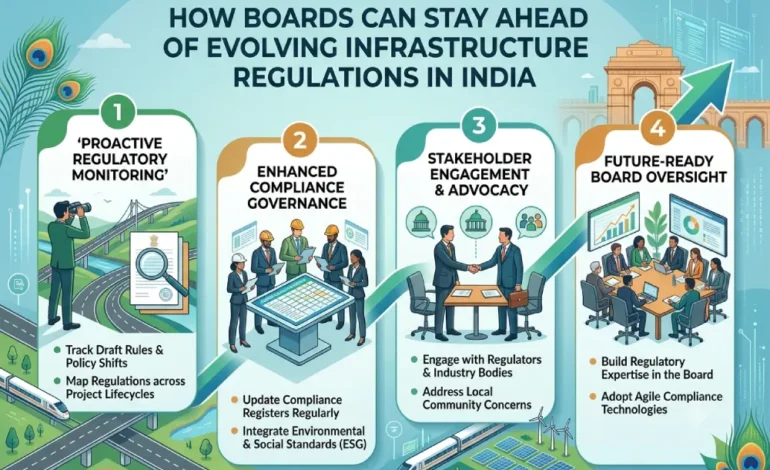
The single most useful structural change a board can make is to convert regulatory tracking from an ad hoc briefing into a standing agenda item, reviewed at a fixed cadence regardless of whether anything “significant” has happened. A quarterly slot dedicated purely to what has changed since the board last met — SEBI circulars, relevant tribunal rulings, state RERA developments, IBBI consultations — creates a discipline that ad hoc escalation cannot replicate.
The value is not just informational. It signals to management that the board expects to be told about regulatory shifts as a matter of routine, not only when someone judges them significant enough to raise. That shift in expectation, over time, changes what gets surfaced and how quickly.
Assign Ownership of Each Regulatory Domain to a Named Director
Diffuse responsibility produces diffuse attention. In boards that handle this well, individual directors — often independent directors with relevant background — are assigned ownership of tracking specific domains: one follows SEBI and capital markets closely, another follows insolvency and tribunal jurisprudence, another follows state-level RERA and land-use regulation relevant to the company’s project geographies.
This does not make these directors the compliance function. It gives the board genuine, distributed literacy rather than relying entirely on a single officer’s judgment about what merits escalation.
Treat Tribunal Rulings as Forward-Looking Signals, Not Just News
One habit separates a proactive board from a reactive one: how it reads tribunal rulings. Most boards treat a relevant NCLT or NCLAT judgment as closed news — something that happened to another company, filed away. A more useful habit is to ask what the ruling implies about how the tribunal is likely to approach a similar question if it arose in the company’s own projects.
The trend toward project-specific CIRP, for instance, has direct implications for how any listed developer should structure financing and security across a multi-project portfolio — tribunals are increasingly signalling that isolating financial risk at the project level will be respected. A board that reads that pattern early can restructure financing proactively, well before any project of its own is under stress..
Map Regulatory Exposure Against the Project Portfolio, Not Just the Entity
Because so much recent regulatory activity in this sector is explicitly project-specific — SPV treatment after a concession ends, CIRP confined to a single defaulting project, homebuyer claims interacting with RERA and IBC timelines — boards benefit from maintaining a regulatory exposure map organized by project, not merely by legal entity. For each major project, the board should see, at a glance, RERA registration status, pending proceedings, financing and security structure, and exposure to recent tribunal trends.
Much of the underlying work belongs to compliance. The board’s role is to insist the map exists, review it with genuine engagement, and ask pointed questions where a project’s structure looks exposed to a direction the board has already identified as gaining momentum.
Build Direct Channels to External Regulatory Expertise
Internal compliance and legal teams are essential, but they are also close to the day-to-day pressures of the business. Boards that stay genuinely ahead often maintain direct, periodic access to external regulatory and insolvency law expertise — not to replace internal compliance, but to pressure-test its read of where things are heading. A biannual external counsel briefing on SEBI policy direction or tribunal jurisprudence, presented directly to the board, gives directors an independent perspective to calibrate against what they hear internally.
Build Regulatory Scenarios Into Project Timeline Planning
The most practical output of all this tracking is using it to inform project timelines before they are finalized. If a board’s standing regulatory watch has identified that tribunals are moving toward stricter project-specific financial ring-fencing, or that a state RERA authority has taken a harder line on possession delay compensation, that intelligence should feed directly into how new projects are financed, sequenced, and disclosed.