Atomic Habits

The Identity Architect: A Deep Dive Review of “Atomic Habits”
We have all seen the distinctive white and yellow cover on airport bookshelves and social media feeds. We all know that Atomic Habits by James Clear is considered a “great” book. But popularity doesn’t always equal personal impact. Having spent significant time with this text, I want to suggest a few specific reasons why you should read this book—and more importantly, why you should read the entire thing rather than settling for a distilled version.
The “Summary Trap” vs. The Full Experience
I have heard a lot about this book for years. I’ve seen the infographics, watched the 10-minute YouTube breakdowns, and read the Twitter threads. But when I actually sat down to read the book, my experience was entirely different.
I usually tell people: don’t just go to summaries of books. Read the book itself. There is a psychological gap between “knowing” a concept and “internalizing” it. Summaries give you the skeleton of the idea, but the book provides the muscle and the blood. When you read the full text, you are exposed to the nuances, the stories, and the gradual build-up of logic that a summary simply cannot replicate. The journey of reading is what creates the mental shift necessary for actual change.
A Global Phenomenon: The History of the 1% Margin
To appreciate the weight of this book, one must look at its history and staggering success. James Clear didn’t become a “habit expert” overnight. He began writing about habits and human potential in 2012 on his personal blog. Over years of consistent research and weekly newsletters, he refined the concepts that would eventually become this “handbook.”
Since its publication on October 16, 2018, Atomic Habits has redefined the self-help genre.
- Sales Records: As of early 2026, the book has sold over 22 million copies worldwide.
- Longevity: It has maintained a near-permanent residence on the New York Times Bestseller list for over 250 weeks—a feat achieved by very few authors in history.
- Global Impact: It has been translated into more than 60 languages, proving that the desire for self-improvement and the mechanics of human behavior are universal, regardless of culture or geography.
The Core Concept: It’s About Identity, Not Just Habits
People often categorize this as a book about productivity or “hacking” your morning routine. While it covers those things, the most important thing is its simplicity in language and friendly overview. But beyond the surface-level tips lies the true heart of the book: Identity.
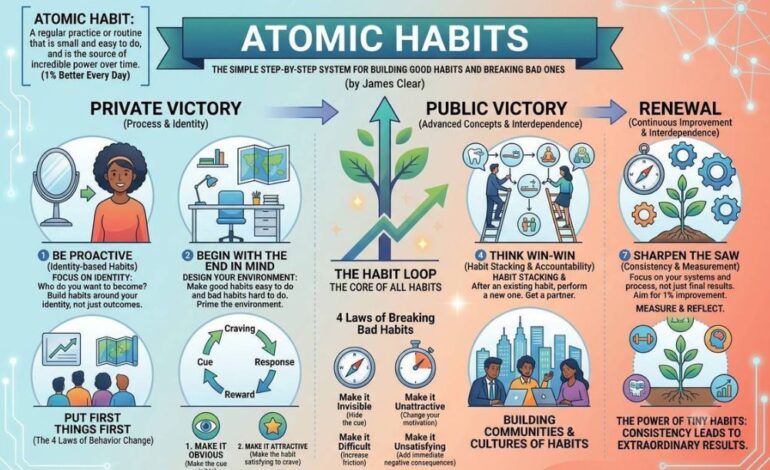
The core concept mentioned here is not just about habits; it is about who you are. Clear argues that most people fail at habit formation because they focus on outcomes (what they want to achieve) rather than identity (who they want to be).
“Every action you take is a vote for the type of person you wish to become.”
This is a profound shift. If you want to stop smoking, you don’t just “try to quit.” When offered a cigarette, a person focusing on outcomes says, “No thanks, I’m trying to quit.” A person focusing on identity says, “No thanks, I’m not a smoker.“
The concepts mentioned throughout the book are based on proper examples given from day-to-day life. Whether it’s the story of the British Cycling team’s “aggregation of marginal gains” or simple anecdotes about keeping a clean desk, Clear makes the abstract feel practical. He shows us that habits are the “compound interest” of self-improvement. Just as money multiplies through compound interest, the effects of your habits multiply as you repeat them.
Maintenance and Deconstruction
A common pitfall in self-help is the obsession with “the start.” We are great at starting things, but terrible at keeping them. Atomic Habits is unique because it tells us not just how to create new habits, but also how to maintain good ones over the long haul.
Equally important is the “negative” side of the coin: how to forget the bad ones and remove them from your life. Clear provides a four-step framework for both:
- The Cue: Make it obvious (for good habits) or invisible (for bad ones).
- The Craving: Make it attractive (for good habits) or unattractive (for bad ones).
- The Response: Make it easy (for good habits) or difficult (for bad ones).
- The Reward: Make it satisfying (for good habits) or unsatisfying (for bad ones).
You can select the chapter or portion which you feel you have to improve or focus on today. This non-linear usability is what makes it a staple on the desks of CEOs, athletes, and parents alike.
Final Thoughts
In a world full of complex “life hacks” and overwhelming scientific jargon, Atomic Habits stands out for its accessibility. It doesn’t ask you to change your life in a day; it asks you to change 1% of your life today.
If you have been relying on summaries or videos, you are missing the depth of the identity-shift that James Clear so masterfully describes. Pick up the book, keep it on your nightstand, and treat it like the manual for your future self. It is a guide not just for doing better, but for being better.