
ISO 9001 And ISO 45001: The Boardroom’s Secret Weapon For Risk Reduction

Ask most directors what ISO 9001 and ISO 45001 certifications mean to their company, and the honest answer, more often than not, is a marketing asset — a badge on a tender document, a line in a sustainability report, evidence to a client that the company takes quality and safety seriously. Few boards think of these certifications as what they actually are, at their core: a documented, auditable system of management decisions and controls that, when genuinely implemented, forms one of the most practical legal and governance defenses available to senior leadership.
What These Standards Actually Require, in Plain Language
ISO 9001 – Quality
Define how work should be done, follow the same process, check the results, fix problems, and keep proper records.
ISO 45001 – Safety
Find hazards, control risks, involve workers, and keep improving workplace safety with proper records.
Neither standard, by itself, guarantees good outcomes. A company can hold both certifications and still experience a serious quality failure or safety incident. What these standards genuinely provide, when implemented with real substance, is a documented, defensible record that the organization had a systematic process for managing risk, that senior leadership had visibility into that process, and that failures, when they occurred, happened despite a genuine system of controls rather than in the complete absence of one.
Why This Matters Specifically for Legal Liability
The legal exposure facing directors and senior management, particularly following a serious safety incident or quality failure, often turns on a specific and uncomfortable question: did leadership know, or should they reasonably have known, about the risk that led to the failure, and did they have a genuine system in place to manage it? This is the question that determines whether an incident is treated as an unfortunate but unavoidable event or as evidence of governance negligence.
A genuinely implemented ISO 45001 system creates a direct, contemporaneous record that speaks to exactly this question. Hazard identification logs, risk assessments, safety committee minutes, and management review documentation collectively demonstrate the organization had identified relevant risks, assigned responsibility, and maintained active monitoring. When an incident occurs despite this system, the conversation shifts: from “did this company have any safety process at all” to “did this specific control, within an otherwise functioning system, fail on this occasion, and why.”
COUNSEL VIEW“The single worst position for a director to be in during an investigation is explaining why there was no system. The second worst position, but a genuinely defensible one, is explaining why a real system, with real records, didn’t catch this particular failure. Those are completely different conversations, and the difference is almost entirely the quality of the documentation trail.”
— a construction lawyer who represents companies and directors in safety litigation
The same logic applies to ISO 9001 in quality-related disputes and defect liability claims. A documented quality management system showing consistent inspection protocols, material testing records, and non-conformance tracking provides a materially different evidentiary position than an organization that can only point to informal practices and undocumented assurances.
Why Boards Should Treat This as Governance, Not Just Operations
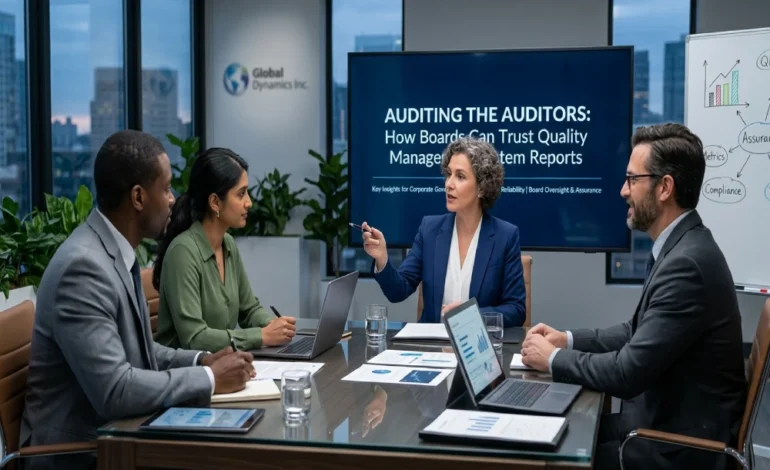
The legal protection these standards offer is directly proportional to the genuine, visible engagement of senior leadership with the system, not merely its existence on paper. A certification maintained purely at operational level, with the board receiving only a summary confirmation of renewal, captures only a fraction of the protective value these systems can offer.
ISO 45001 explicitly requires top management involvement, not as a formality but as a structural element of the standard itself. Management review meetings, where senior leadership actively reviews safety data and incident trends, are precisely the kind of documented senior engagement that becomes most valuable in a legal context, because they demonstrate oversight reached the level of the organization actually responsible for governance.
COUNSEL VIEW“I make sure the board minutes actually reflect substantive safety discussion, not just a line that says ‘safety report noted.’ If something ever goes wrong, the difference between those two sentences in the minutes could be the difference between demonstrating genuine oversight and demonstrating none at all.”
— a board member serving on safety committees of multiple infrastructure companies
Genuine Implementation vs. Certificate-Chasing
None of this legal and governance value exists if these standards are implemented as “certificate chasing” — building just enough documentation to pass an external audit, without the underlying processes actually functioning between audits. Auditors and legal advisors learn to recognize this pattern quickly: perfectly organized document files, produced specifically for the annual audit, that bear little resemblance to how work is actually managed day to day.
The legal risk of certificate-chasing is arguably worse than having no certification at all. Evidence that a certified system existed largely for external presentation, rather than genuine internal use, can suggest the organization understood the relevant risks well enough to document them for an auditor, while choosing not to act on that understanding operationally — a considerably worse position than never having formally identified the risk at all.
What Genuine Implementation Looks Like at Board Level
Genuine implementation means management review meetings are attended and substantively engaged with by senior leadership, not delegated entirely to the quality or safety department. It means non-conformance and corrective action data are reviewed at board or committee level with enough regularity to identify patterns, not simply confirmed as “closed.” It means internal audit findings are treated as genuine input to board risk oversight, rather than filed as a formality.
It also means resisting the temptation to treat certification renewal itself as the goal. The external audit is a periodic checkpoint, not the system itself. A board that only engages with these standards in the weeks before a renewal audit is unlikely to build the kind of documented, contemporaneous record that provides genuine legal protection when it matters.
The Strategic Value Beyond Liability Protection
Genuinely implemented quality and safety management systems also produce direct commercial value. Public infrastructure tenders increasingly scrutinize the substance behind ISO certification, not merely its existence. Institutional investors and lenders applying ESG-linked financing criteria review the genuine functioning of these systems as part of due diligence, and insurance underwriters increasingly factor in the depth and continuity of these practices when pricing risk. In each context, the difference between certificate-chasing and genuine implementation is visible to a sophisticated counterparty.
A Closing Thought
ISO 9001 and ISO 45001 are usually discussed in boardrooms, when discussed at all, as operational certifications maintained by the quality and safety functions and reported upward as a compliance formality. This framing significantly undersells what these standards can offer a board that engages with them genuinely: a structured, documented, legally meaningful record that demonstrates senior leadership’s active oversight of quality and safety risk, built through ordinary discipline rather than assembled defensively after a crisis has already occurred.
Treated this way, ISO 9001 and ISO 45001 stop being compliance line items and become one of the most practical, underused instruments a board has for reducing its own legal and reputational exposure, while genuinely reducing the underlying risk to the people and projects the company is responsible for.