The Board’s Role in Zero-Harm: Making Worker Safety a Corporate Governance Priority

I have stood at the edge of a site three separate times in my career while a stretcher was carried out. Two of those workers went home to their families, eventually, after long recoveries. One did not. Twenty-three years in this industry means you carry a specific kind of memory that people outside construction rarely have to hold — the memory of a name, a face, a family, attached to a number that later shows up in a report as a single incident in a lost-time frequency rate.
That gap — between what a safety incident actually is on the ground and what it becomes by the time it reaches governance — is, I think, the central problem with how most boards handle worker safety today. Safety is treated as an operational metric, owned by the site, summarized by a manager, and reported upward in a format designed to fit neatly into a quarterly pack. It rarely makes it to the main agenda of a board meeting with the weight it deserves. This article is about why that has to change, and what it actually looks like when it does.
Why Safety Belongs on the Main Agenda, Not the Appendix
In most construction and infrastructure companies I have worked with or advised, safety performance is reported to the board, but in a specific way: a slide near the end of the deck, a lost-time injury frequency rate, a handful of leading indicators, presented by an EHS head who is usually not in the room when the board discusses capital allocation, project approvals, or executive compensation. Safety, in other words, is treated as an operational report rather than a governance matter.
This structural placement matters more than it looks. When safety sits at the end of the agenda, it inherits the psychology of an afterthought — reviewed quickly, questioned lightly, and rarely connected to the decisions that actually drive risk on-site: bid pricing that squeezes subcontractor safety budgets, schedule compression that increases exposure hours, or expansion into new geographies without proportional investment in safety systems.
“We used to review safety like we reviewed the cafeteria budget. Important, sure. But nobody thought a bad quarter there could kill someone.”
The Cost of Treating Safety as a Site-Level Metric
I want to be specific about what gets lost when safety stays a site-level report rather than a board-level priority. It is not simply a matter of tone or emphasis. Specific, consequential decisions get made without safety input precisely because safety never sits in the room where those decisions happen.
Consider bid approvals. A board approving a major project bid is, functionally, approving a budget and a schedule. If that budget and schedule were built without genuine input from anyone empowered to say the timeline doesn’t leave room to work safely, the board has unknowingly approved a safety risk while believing it approved a commercial decision. I have seen this exact sequence play out — an aggressive schedule approved at the top, filtering down as pressure, eventually expressing itself as shortcuts around scaffolding inspection or permit-to-work discipline. By the time an incident occurs, it looks like an operational failure. Its actual origin was a governance decision made months earlier.
Consider, too, how safety incidents are reviewed after the fact. A serious incident often triggers an internal investigation and a summary report to the board — written in language calibrated to minimize legal and reputational exposure rather than to convey the full severity of what happened and why. A board that only sees the sanitized version of its own incidents cannot meaningfully govern the underlying risk.
What “Zero-Harm as a Governance Priority” Actually
Means
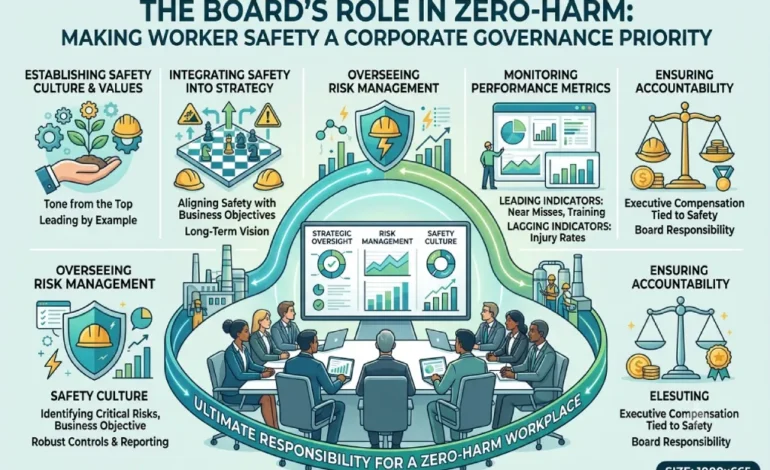
“Zero harm” has become something of a corporate slogan, printed on hoardings and safety inductions, often disconnected from what actually happens in a boardroom. Making it a genuine governance priority means something more specific.
What already went wrong
Lost-time injury frequency rate, fatality counts, reportable incidents — necessary, but tell the board only after the fact.
Where risk is building
Near-miss reporting rates, completed safety audits, permit-to-work compliance, worker confidence to stop unsafe work.
It means, first, that safety performance is reviewed by the full board, not delegated entirely to a subcommittee that reports back in summary form. It means, second, that metrics presented go beyond lagging indicators alone and include the leading indicators above — a board that only sees lagging indicators is, in effect, governing by rear-view mirror. It means, third, that safety is explicitly connected to the decisions that create risk — bid approvals, schedule commitments, contractor selection, capital allocation for safety systems — rather than reviewed as an isolated report.
“You cannot approve an aggressive schedule in one agenda item and then ask why lost-time injuries went up in the next one. Those two things are not unrelated. They are the same decision, seen from two different rooms.”
The Reputational Dimension Boards Often Underestimate
There is also a governance dimension to worker safety that goes beyond the moral and human obligation, though that obligation should be sufficient on its own. Safety performance has become a material factor in how infrastructure and construction companies are evaluated by investors, lenders, and regulators. ESG-linked financing, increasingly common in this sector, often ties borrowing costs directly to safety and sustainability performance. Institutional investors now routinely ask about fatality rates and safety governance structures during due diligence, and many public infrastructure tenders now explicitly weight safety track record in contractor selection.
“Our safety record isn’t just about protecting workers anymore, though that should be reason enough. It’s becoming a line item in our cost of capital.”
Practical Steps for Making Safety a Genuine Board Priority
Move safety to the front of the agenda, not the back. Where an item sits shapes how much attention it receives.
Give the safety presenter direct access to the board. Let the discussion happen without filtering.
Require an explicit safety assessment. Include it in every major decision.
Build board-level safety literacy. Visit sites and speak directly with workers.
Link executive rewards to safety. Measure leading indicators, not only outcomes.
A Closing Thought
I began this article with a memory I still carry, and I want to end with the same honesty. Every serious safety incident I have witnessed in twenty-three years had, somewhere upstream, a decision made by people who were not thinking about that specific worker, on that specific day, doing that specific task. They were thinking about a schedule, a budget, a bid. That is not a criticism of any individual — it is a description of how organizational distance works, and it is exactly why governance structure matters so much.
A board that treats worker safety as a genuine governance priority is closing the distance between the decisions made in a boardroom and the consequences felt on a scaffold, in a trench, or beneath a crane. That distance, left unmanaged, is where the worst outcomes in this industry have always come from. Closing it, deliberately and structurally, is one of the most consequential things a board can do — for its workers, and ultimately for the company itself.