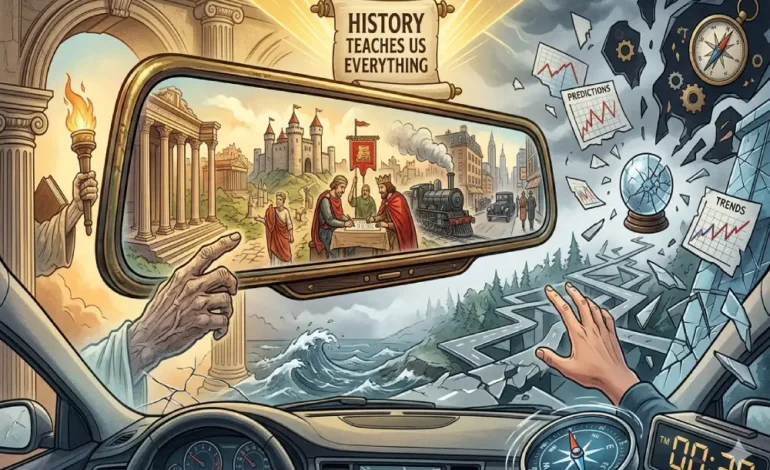
The Illusion of the Rearview Mirror: Why History Teaches Us Everything but Predicts Nothing

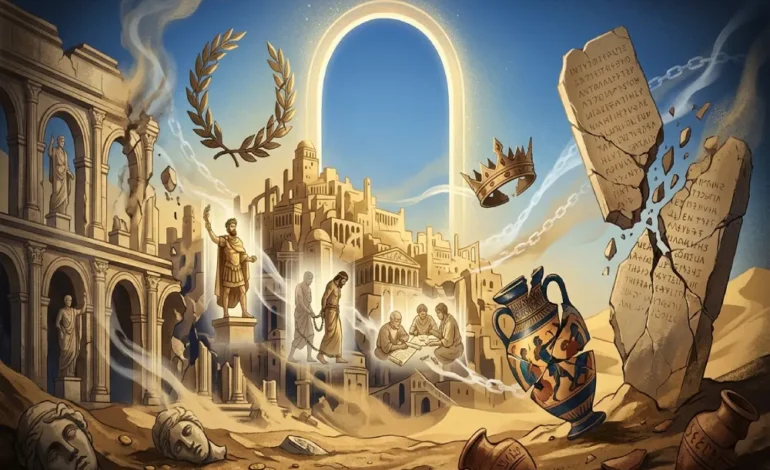
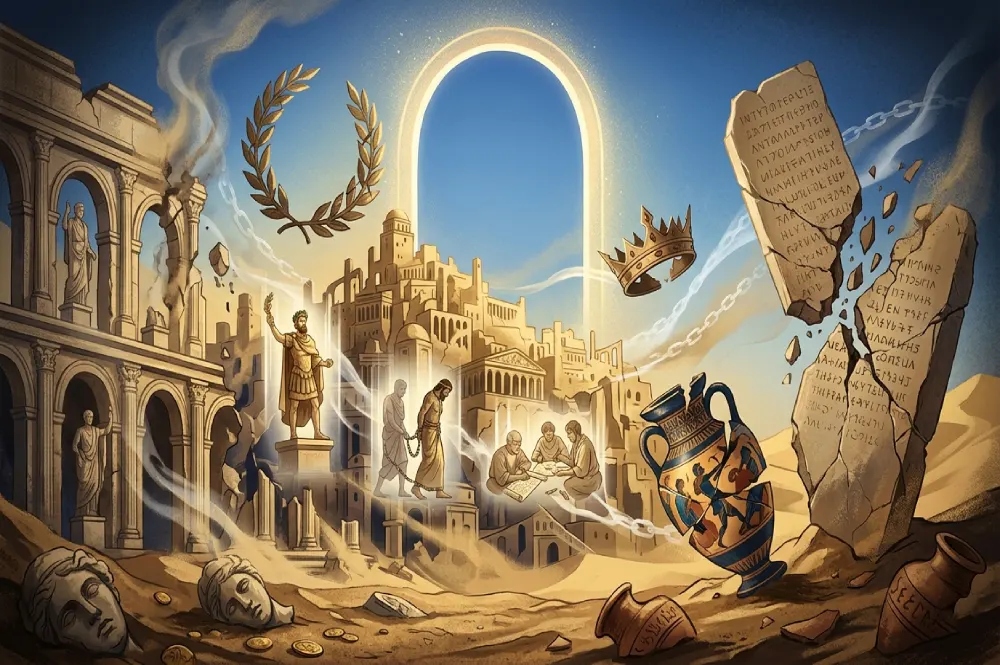
There is a famous proverb, often attributed to George Santayana, that suggests those who do not learn from history are doomed to repeat it. It’s a comforting thought. It implies that if we simply study the past diligently enough, we can build a shield against the future. We treat history like a map, believing that if we know where the potholes were yesterday, we won’t fall into them tomorrow.
But if we look closer at the reality of our world, we have to ask: Is history actually predictable? Can we truly map our future based on what has already happened?
The uncomfortable truth is that while history is an incredible teacher, it is a terrible fortune teller. We can learn many things from the past, but we cannot predict the future with it.
The Myth of the Predictable Catastrophe
Think back to the most defining moments of the last two decades. Did we predict the COVID-19 pandemic while we were ringing in the New Year of 2020? Did the world see the 2008 real estate crisis coming before the floor dropped out from under the global economy? Did we foresee the specific timing and scale of the wars currently shifting our geopolitical landscape?
The answer is a resounding no.
These events are what philosopher Nassim Taleb calls “Black Swans” outliers that are impossible to predict, carry a massive impact, and are only explained away with “hindsight bias” after they happen. We look back and say, “The signs were all there,” but in the moment, we were blind. History doesn’t repeat itself in a straight line; it zig-zags, leaps, and occasionally falls off a cliff.
Learning to Defend, Not to Foresee
If history is not a crystal ball, why do we bother with it? Your notes hit on a vital distinction: we don’t learn from history to avoid the catastrophe; we learn from it to defend ourselves when the catastrophe inevitably occurs.
We can learn to build better armor, even if we don’t know who will throw the next stone. This defense comes in several forms:
- Technological and Physical Defense: We develop more powerful weapons and systems to protect our borders and our infrastructure.
- Biological Resilience: We learn that the best defense against a microscopic enemy is good health, robust immunity, and the scientific knowledge to develop vaccines and treatments.
- Mental and Systematic Flexibility: We learn that “perfect fitness” a combination of strength and flexibility—is what allows a society to bend without breaking.
However, there is a catch. These factors help us defend against the known types of threats. They provide us with tools, but they do not provide “surety.” They do not guarantee that we will live or sustain ourselves in the face of an entirely new kind of future.
The Survival of the Brain
In the deep past, the world has seen the extinction of entire civilizations and even entire species. The dinosaurs, which ruled the Earth for millions of years, disappeared in what was, geologically speaking, a heartbeat. Yet, humanity has survived.
We didn’t survive because we were the strongest or the fastest. We survived through production and learning. The human brain is our greatest evolutionary advantage. It allows us to simulate scenarios, to cooperate in large groups, and to learn from the mistakes of those who came before us.
But there is a dangerous side to this success. Because we have survived so much, we have developed a deep-seated intuition a “gut feeling” that we are invincible. We believe that because we survived the Ice Age and the Plague, we will survive whatever comes next. This intuition is a double-edged sword. It gives us the courage to keep going, but it also creates a false sense of security.
The Giant Monsters of Today
Today, we face what we might call “Giant Monsters” threats that are so large and slow-moving that our “history-based” brains struggle to compute them.
Global Warming and Nuclear Threats are not like the wars of the past. They are existential. They are not local problems that can be solved by moving to a different valley or building a higher wall. They require a level of global cooperation and long-term thinking that human history has rarely demonstrated.
Furthermore, we tend to ignore the “Total Outliers.” We live our daily lives ignoring the possibility of an asteroid hitting the Earth or sudden, violent changes in the universe or our solar system. We treat the stability of the sun and the stars as a given, simply because they have been stable for the duration of human memory. But history deep, cosmic history shows us that nothing is permanent.
The Paradox of Perception
Our perception of life is often a struggle between two forces: the data of the past and the uncertainty of the future.
We must continue to study history, not because it tells us what will happen, but because it tells us what can happen. It humbles us. It reminds us that civilizations are fragile and that survival is not a right, but a continuous effort.
We shouldn’t call the proverb “stupid” necessarily, but we must acknowledge it is incomplete. Learning from history won’t stop the world from changing in ways we can’t imagine. However, it might give us the “flexibility and strength” to remain standing when the next unpredictable wave hits.
The goal is not to predict the future perfectly. The goal is to be the kind of people and the kind of civilization that can learn fast enough to survive a future that looks nothing like our past.