
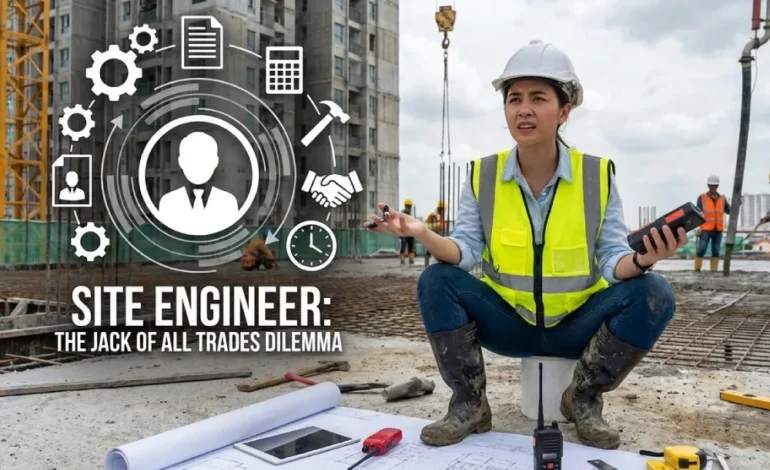
Site Engineer Roles: The “Jack of All Trades” Dilemma in Construction

Introduction: The Confusion on Day One
If you ask ten different people what a Site Engineer does, you will likely get ten different answers. Ideally, the role should be well-defined, but the reality on the ground is often chaotic.
One of the biggest challenges in the construction field especially in typical contracting firms is that there are often no “red lines” marking where a Site Engineer’s job begins and ends. From the initial demarcation of the plot to the final handover to the client, the Site Engineer is often the only constant performing agent.
The “Textbook” Definition (What HR Says)
Technically, a Site Engineer is an intermediary between the design team (architects/consultants) and the workforce. Standard industry job descriptions usually list these specific duties:
- Supervising the execution of work as per drawings.
- Ensuring technical specifications are met.
- Reporting progress to the Project Manager.
In a perfect world (or a very large MNC), this is all you would do. You would have a separate Quality Engineer, a Safety Officer, a Quantity Surveyor, and a Store Keeper.
This article explores the difference between the “textbook” definition of a Site Engineer and the messy, demanding reality of the job site.
The Reality: The “Do-It-All” Engine
However, based on my experience at actual sites, the reality is vastly different. If you are a Site Engineer in a typical mid-sized contracting firm, you aren’t just supervising you are witnessing and executing everything.
Your role often expands into areas that textbooks don’t warn you about:
- The Substitute Role: If there is no dedicated Quality or Safety Engineer, you are responsible for checking the stability of the structure and the safety of the workers.
- The Coordinator: You are constantly dealing with surveyors, subcontractors, and consultants to resolve drawing queries immediately so work doesn’t stop.
Real-World Conflict: The “Sunken Slab” Standoff Let’s look at a classic site battle. Imagine the Architect’s drawing shows a 150mm sunken slab for a toilet, but the Plumbing Consultant’s drawing shows a pipe diameter that requires a 200mm depth to get the proper slope.
You are on site. The shuttering is fixed, the steel is tied, and the concrete mixer is booked for tomorrow morning. You call the Architect, but they need to “discuss it with the consultant.”
This is the Site Engineer’s nightmare.
- If you pour: You might have to break the concrete later because the pipes won’t fit (huge rework cost).
- If you wait: You have a gang of 15 masons and helpers who will sit idle tomorrow, costing the company money.
In the textbook, you just “raise a query.” In reality, you are frantically coordinating a three-way call, begging for a decision by 5 PM, or trying to find alternative work for your labour force to save the day.
Resource Management: You aren’t just looking at drawings; you are handling material procurement, delivery, and even stocking.
The Idle Worker Pressure One of the most critical, unwritten responsibilities is labour management. You are responsible for the day-to-day planning with one major goal: ensuring workers do not sit idle the next day. If the material isn’t there, the labour cost is wasted. This means you are constantly calculating requirements for sand, cement, and Kapchi (coarse aggregate) to ensure the site runs like a well-oiled machine.
The “Red Line”: What You Should NOT Do
Because the role is so broad, many new engineers fall into the trap of trying to do everything. This is dangerous. It is vital to know what you are not supposed to do.
Site Engineers should avoid High-Level Decision Making, such as:
- Aesthetics: Selecting colours, tile patterns, or finishes.
- Commercials: Vendor selection or finalizing rates.
- Policy: Changing project scope without approval.
These decisions belong to the Project Manager, the Procurement Team, or Top Management in consultation with the client. Stepping into this territory without authorization can lead to costly disputes and rework.
Analysis: Why the Ambiguity Exists?
Why is this role so confusing? It often comes down to budget and company culture. In many projects, hiring separate heads for Quality, Safety, and Stores is seen as an overhead cost the company wants to save. Therefore, the burden falls on the Site Engineer.
This all-in-one approach builds immense character and technical knowledge, but it can also lead to burnout if boundaries aren’t set.
Conclusion: Clarity is Key
If you are a Site Engineer who has newly joined a site, do not assume your role is clear. It is a must to clarify your responsibilities immediately.
Ask your reporting manager: What exactly am I supposed to do, and more importantly, what am I NOT supposed to do?
Having this clarity allows you to prioritize your daily tasks and effectively manage your subordinates. Without it, you are just a firefighter running from one crisis to another. Define your role, or the site will define it for you.