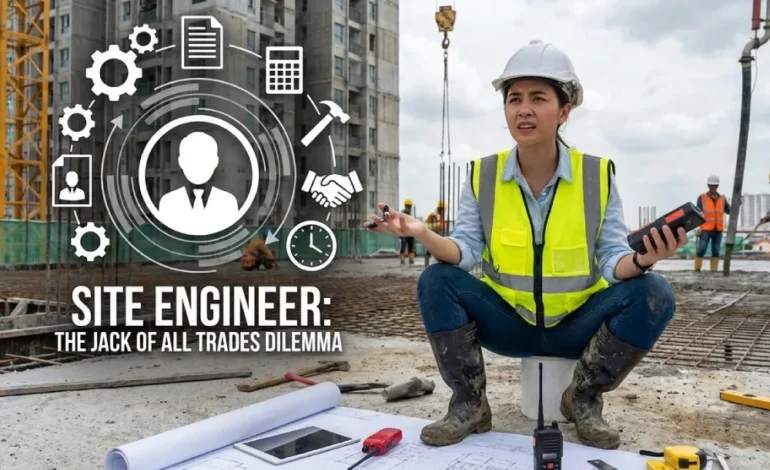

Eating the Elephant: How to Manage Massive Construction Projects One Piece at a Time

The Trainee’s Panic: Standing at the Foot of the Mountain
I still vividly remember my first few days as a trainee engineer at a construction site. I walked through the main gate, looked up, and felt a sinking sensation in my stomach.
The site was massive. There were excavators digging in one corner, steel reinforcement being tied in another, shuttering materials being unloaded, and hundreds of workers moving around like ants. The sheer scale of it was terrifying. I remember thinking, “How am I supposed to handle this? How can one person possibly track the drawings, the manpower, the materials, and the quality for something this huge?”
It wasn’t just the physical size of the building; it was the mental load. As a site engineer, you are the pivot point. You have to study the drawings, translate them into instructions for the labour force, check the quality, manage the speed of work, and ensure safety.
In those early days, the pressure was suffocating. I felt like I needed to know everything, everywhere, all at once. I tried to read every drawing and memorize every page of the contract specifications. The result? I was overwhelmed, anxious, and frankly, ineffective.
The Realization: Breaking the Monolith
As I gained experience and completed a few projects, the fog began to clear. I realized I had been looking at the project all wrong. I was trying to swallow the entire building whole.
There is an old saying: “How do you eat an elephant? One bite at a time.”
Construction management is exactly the same. You cannot build a high-rise in your mind all at once. You have to break it down. I learned that the secret to sanity on a construction site is Selective Focus.
The “Foundation” Approach: Tunnel Vision is Good
Let’s take a practical example. Suppose you are assigned to supervise the foundation work of a specific block.
In my early days, I would have worried about the column lap lengths on the 10th floor or the finishing items for the lobby while standing in the foundation pit. This was a waste of mental energy.
The “One Piece” approach dictates that when you are in the foundation, the rest of the building does not exist.
- Focus on the Here and Now: You only need to look for things immediately relevant to that pit.
- The Specifics: What is the excavation depth? What is the concrete grade (M30, M40, etc.)? What is the reinforcement detailing for the footing?
- Ignore the Noise: You don’t need to know the specification for the terrace waterproofing or the tile selection for the bathrooms yet.
By narrowing your vision to the immediate task, the “monster” project becomes a series of small, manageable checklists. You stop worrying about the whole war and start winning the small battles.
Navigating the Paperwork: The “Just-in-Time” Strategy
One of the biggest sources of anxiety for new engineers is the documentation. A typical project has hundreds of drawings, a Bill of Quantities (BOQ) that runs into thousands of lines, and a Technical Specification book that is 500 pages thick.
If you try to read the full specification book from Page 1 to Page 500 like a novel, you will not only get bored, you will forget 90% of it.
Instead, use the Reference Method:
- The BOQ is your Map: The Bill of Quantities tells you what is being executed. Glance through it to see the item description.
- The Specs are your Dictionary: If the work is “Plastering,” go to the index of the Specification book, find the “Plastering” section, and read only those 5 pages.
- What is the sand ratio?
- What is the thickness?
- What is the curing period?
Read it quickly, understand the limits set by the contract, and then go to the site. This “Just-in-Time” learning ensures that the information is fresh in your mind when you actually need it.
Note: While I advise not getting bogged down by reading the whole book at once, it is risky to work without reading at all. The balance is to read strictly what is relevant to the ongoing activity.
The Trap of Hearsay: Why Documents Beat Words
As you adopt this “One Piece at a Time” habit, you will develop a critical skill: The ability to verify.
On a construction site, information flows rapidly, and often, inaccurately.
- A foreman might tell you, “Sir, we always use 10mm steel for this span.”
- A senior might say, “Don’t worry, the grade is M25.”
The catch here—and this is the most important lesson I learned—is that you must never depend solely on what others tell you. People have faulty memories. Old habits from previous sites often bleed into new projects where the rules might be different.
Instead of relying on hearsay, rely on the document. When you focus on one small piece of work, you have the time to pull out the GFC (Good for Construction) drawing and check it yourself. You have the time to open the specific page in the BOQ.
This shift transforms you from a “Supervisor” to an “Engineer.” A supervisor shouts instructions based on habit; an Engineer gives instructions based on data.
Conclusion: From Reading to Understanding
Eventually, this piecemeal approach accumulates. Today you study the foundation specs. Next month, you study the column specs. Six months later, you study the slab and beam specs.
By the end of the project, you will have read that 500-page book, but you will have done it in digestible chunks that actually made sense in the real world.