The Greatest Warrior Of The Mahabharata

Why Devaki Stands Above All Warriors — In Spirit, Sacrifice, and Strength
A Reflective Essay on Inner Warfare, Motherhood, and the Unsung Heroines of the Epic
✦ ✦ ✦
I. Rethinking the Warrior
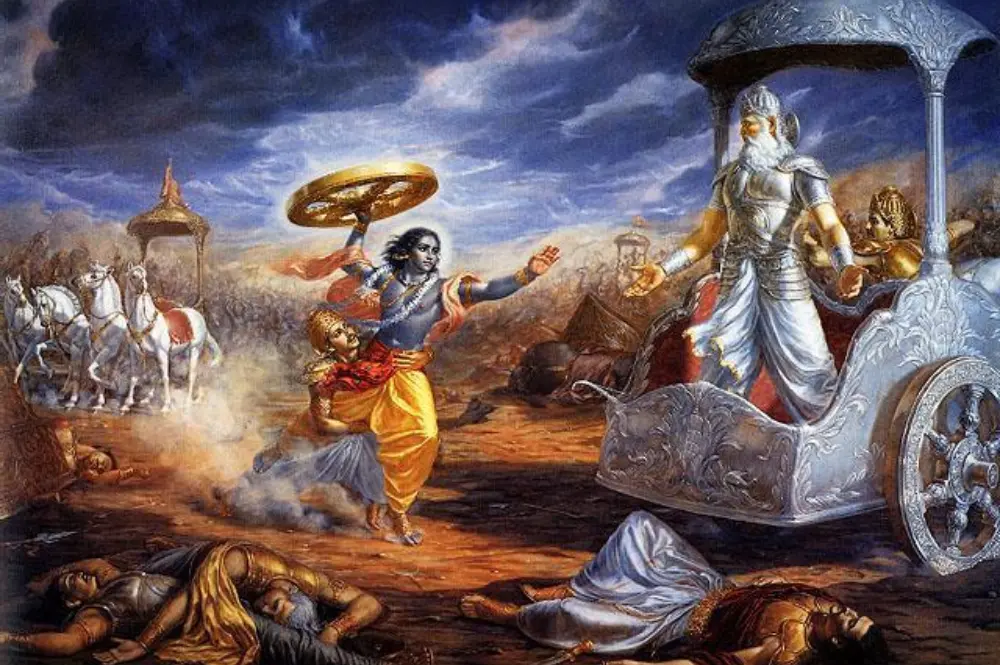
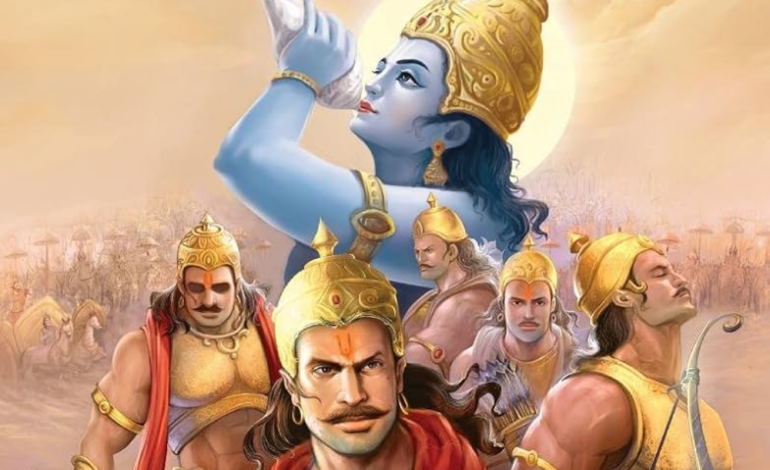
When most of us think of the greatest warrior in the Mahabharata, the mind races instantly to the battlefield of Kurukshetra. We imagine blazing chariots, divine weapons, and the thunderous clash of armies. We think of Arjuna, the peerless archer whose bow Gandiva could split the sky; of Bhishma, the grandsire who lay on his bed of arrows for fifty-eight days, still alive by sheer willpower; of Karna, the tragic hero whose loyalty and generosity made him equal to — or perhaps greater than — any king or god. Type any query into a search engine and you will find endless debates, elaborate YouTube videos, and detailed blog posts comparing these formidable figures.
But here is a thought that came to me one quiet afternoon, a name that floated to the surface of my mind that most people might not have considered: What if the greatest warrior of the Mahabharata was a woman? And not just any woman — a woman who never once lifted a sword, drew a bow, or rode into battle? What if the greatest war she ever fought was waged entirely inside her own heart and body?
I am not talking about physical strength or martial skill alone. True warriorhood encompasses mental strength, spiritual resilience, and the capacity for sacrifice beyond anything the battlefield demands. By those standards, women have always been warriors — often the greatest ones. And nowhere is this truth more powerfully embodied than in the story of Devaki.
Devaki — The Greatest Warrior | An Essay on the Mahabharata
“The most difficult battles are not fought on any field — they are fought in silence, in the heart, where no one can see.” — Ancient wisdom
✦ ✦ ✦
II. The Women Warriors of the Mahabharata
The Mahabharata is, on the surface, a story about men and their wars. Yet the epic is riddled with women of extraordinary strength — mental, moral, and spiritual. We know of Draupadi, whose dignity and burning sense of justice fueled an entire war. We know of Gandhari, who blindfolded herself for a lifetime out of devotion to her husband and whose grief at the end of the war was so immense that her gaze — when she finally opened her eyes and looked upon Krishna — scorched his feet. We know of Kunti, who bore impossible burdens with quiet, steely grace. And some would even call Amba a warrior, for she pursued justice for a wrong done to her across lifetimes, ultimately reincarnating as Shikhandi to bring about Bhishma’s death.
These women fought wars more challenging than any external conflict. There are no weapons to defend in such wars. The only shield is your own mental strength; the only sword is your will. These inner battles leave no visible wounds, yet they reshape the soul more profoundly than any arrow or mace ever could.
Among all these extraordinary women, one stands apart. One woman’s story — though less often told — represents the most staggering act of sacrifice and silent courage in the entire epic. That woman is Devaki, the mother of Lord Krishna.
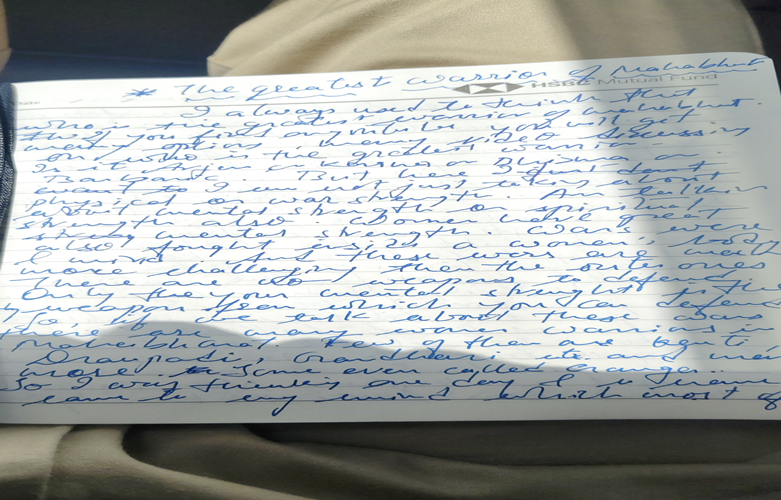
The author’s original handwritten notes exploring the concept of Devaki as the greatest warrior of the Mahabharata
✦ ✦ ✦
III. The Story of Devaki — A War Fought in Chains
Most of us have heard her name, but few pause to fully absorb the magnitude of what she endured. Devaki was the daughter of a Yadava nobleman and the sister of the tyrant King Kansa of Mathura. On the day of her wedding to the noble Vasudeva, a divine prophecy shook the heavens: the eighth child born to Devaki would kill Kansa and put an end to his reign of evil.
Kansa’s response was swift and terrible. He imprisoned both Devaki and Vasudeva in a dark dungeon. And there, in that prison, began a war that would last for years — a war without armies, without weapons, without any glory or recognition. Just a woman in chains, facing an impossible choice, repeating it eight times.
“The bravest thing I ever did was continuing my life when I wanted to die.” — Juliette Lewis
Inside that prison, Devaki faced two options that would shatter any human being. She could refuse to give birth, attempting to deny the prophecy its children — but that would be futile, and it would mean denying life itself. Or she could give birth to each child, look into their eyes, hold them in her arms, and then watch as Kansa stormed in and killed them, one by one, before her eyes. She chose to face her dharma head-on. She chose to give life, over and over, even knowing that each birth would be followed by unbearable grief.
She gave birth to six children. Six times, she held a newborn to her chest. Six times, she felt that unique, ferocious love that floods a mother’s heart in the first seconds of a child’s existence. And six times — immediately after birth — Kansa took those babies and killed them. Six times, Devaki experienced the most annihilating grief a human being can know: the death of a child. And yet she did not break. She did not surrender to despair. She selected her dharma — her sacred duty — and held onto it even within those dark walls.
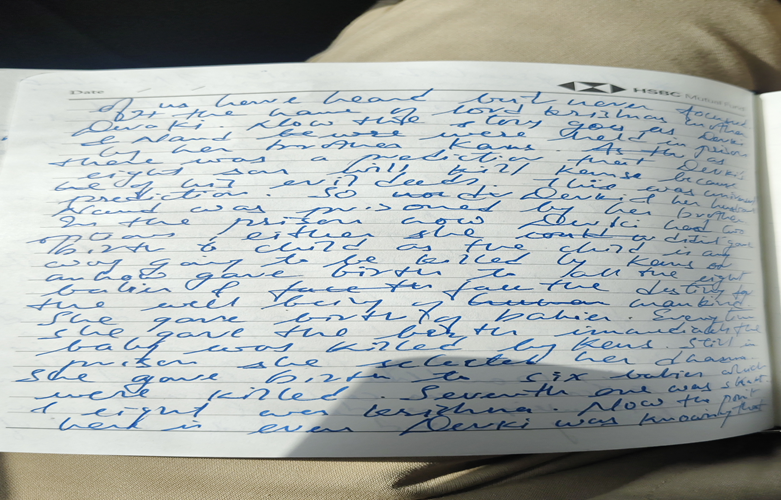
Handwritten notes describing Devaki’s impossible choices inside the prison of Kansa
✦ ✦ ✦
IV. The Seventh and Eighth Children
The seventh child, Balarama, was miraculous transferred from Devaki’s womb to that of Rohini, Vasudeva’s other wife, through divine intervention. This was another loss — not a death, but a disappearance, a child taken before she could even see his face. Still, Devaki endured.
And then came the eighth child. Krishna. The child who would grow up to be the greatest figure in all of Hindu philosophy, the divine charioteer, the speaker of the Bhagavad Gita, the destroyer of Kansa and the saviour of the Pandavas. Devaki knew — perhaps she always knew, with the deep knowing that mothers carry — that this child was different. That this child might survive. That this child was destined for something beyond her imagination.
Yet knowing this did not make the moment of parting easier. Shortly after Krishna’s birth, Vasudeva carried the newborn out of the prison in a basket, crossing the river Yamuna in a storm, to place him in safety with foster parents Nanda and Yashoda in Gokul. Devaki gave birth to Krishna — and then lost him immediately. She did not raise him. She did not see his first steps or hear his first laugh. She did not tell him bedtime stories or wipe away his childhood tears. All those years, all those moments that belong to a mother — she lost them all.
“A mother’s love is the fuel that enables a normal human being to do the impossible.” — Marion C. Garretty
Krishna grew up in Gokul. He became the beloved of Radha and the Gopis, the player of the flute, the slayer of demons. He returned to Mathura after many years, killed Kansa, and finally reunited with his birth parents. Devaki was freed from prison. But she had missed his entire childhood. She met her son again as a young man — a son she had not raised. That reunion, beautiful as it was, came seasoned with an irreplaceable grief: all those years she could never get back.
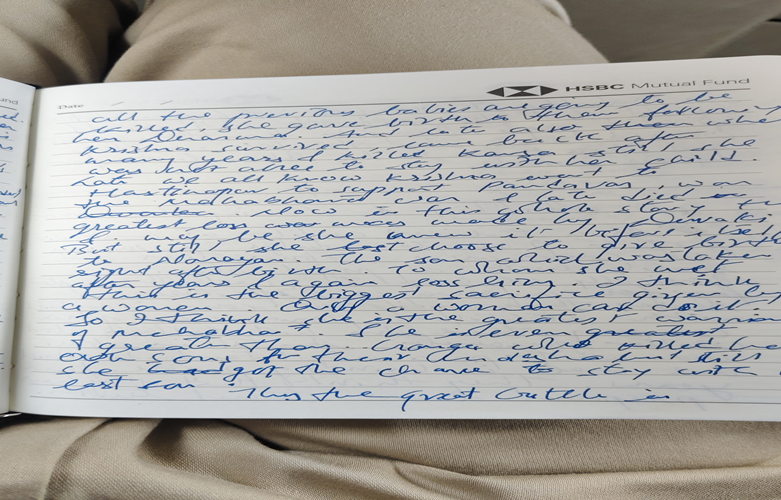
The author’s notes on the final conclusion — why Devaki’s sacrifice surpasses all warriors
✦ ✦ ✦
V. The Biggest Sacrifice Ever Given by a Human Being
Later, Krishna went to Hastinapur to support the Pandavas. He became the architect of the Mahabharata war — the charioteer of Arjuna, the giver of the Gita, the voice of cosmic truth. He lived through the war, saw the destruction of countless kings and heroes, and eventually died in Dwarka, struck by a hunter’s arrow, in circumstances that were partly shaped by Gandhari’s curse. The greatest loss in this whole story, the losses most worth mourning, were made by Devaki.
Perhaps she knew it beforehand. Perhaps she did not. But still she chose to give birth to Narayana — to the divine — knowing the son taken away right after birth might be returned to her after many years, and then be lost again. She chose, again and again, to face loss. I think this is the biggest sacrifice given by a woman. Only a woman can do it.
And so, when I ask myself who is the greatest warrior of the Mahabharata, the answer that comes to me — the one that feels truest — is Devaki. She is even greater than Gandhari. Gandhari willingly lost the use of her eyes her entire life for the sake of her husband’s dignity. That, too, was extraordinary. But Gandhari at least got to be with her children, to watch them grow, to love them in the daily intimate way that is a parent’s greatest joy and privilege. Devaki did not even get that. She gave birth to the greatest soul that ever walked the earth — and she was not given the chance to stay with her last son.
“Of all the rights of women, the greatest is to be a mother.” — Lin Yutang
✦ ✦ ✦
VI. What Truly Makes a Warrior
The Mahabharata itself, in its deepest philosophical passages, distinguishes between different kinds of courage. The Bhagavad Gita — delivered on the battlefield but pointing always at the inner life — speaks of the warrior who conquers the self as greater than one who conquers a thousand enemies. ‘He who has no enemies within himself has no enemies at all,’ the text suggests. By this standard, the truest warrior is the one who conquers fear, grief, attachment, and despair — not the one who simply wields the most powerful weapon.
Devaki conquered all of these. She conquered the fear of death — her children’s deaths and her own spiritual annihilation. She conquered attachment, time and again, letting go of each child even as every instinct in her being screamed to hold on. She conquered despair in the darkest possible circumstances, maintaining her dharma and her grace through years of imprisonment and bereavement. And she did all of this without a single sword stroke, without a single arrow loosed, without a chariot or a divine weapon or an army at her back.
“Strength does not come from physical capacity. It comes from an indomitable will.” — Mahatma Gandhi
There is a profound lesson here that extends far beyond the Mahabharata. In every age and culture, the warriors who are most celebrated are those who win visible, external battles. But the battles that shape history — the battles that shape souls — are often invisible. They are fought in prison cells and hospital rooms, at bedsides and gravesides, in the silence of the night when no one is watching and there is nothing to do but endure. The warriors in these battles rarely receive monuments or songs. But their courage is no less real, and often far greater, than anything achieved on a physical battlefield.
Devaki is a symbol for all such warriors — and in particular for all the mothers, fathers, and caregivers who have loved deeply and lost deeply, who have continued to give of themselves even when giving felt impossible. Her story is not just mythology. It is a mirror held up to the most essential truths of the human condition.
✦ ✦ ✦
VII. Conclusion — The Great Battle Within
In Mahabharata, everyone is fighting for their own idea of glory. Arjuna fights for dharma and honour. Karna fights for loyalty and dignity. Bhishma fights for his oath and his family. Duryodhana fights for pride and power. But Devaki — Devaki fights for something none of them fully understood. She fights simply to continue loving, in a world that destroys everything she loves. She fights to give life even when life returns only sorrow. She fights to remain human, to remain a mother, through circumstances that would have broken lesser souls completely.
She is, in the truest sense, the greatest warrior of the Mahabharata. Not the most skilled. Not the most powerful. But the greatest — because the war she waged was the most human, the most universal, and the most costly of all. And she won it. Not with victory banners or coronation ceremonies, but with a quiet, undefeated dignity that time has not erased.
The next time someone asks you who is the greatest warrior of the Mahabharata, pause before you answer. Think of Devaki. Think of the prison. Think of eight children. Think of the years of silence and sacrifice. And then ask yourself: what does it truly mean to be a warrior?
“The warrior’s greatest battle is not fought with weapons, but with the silent, relentless courage to remain whole when the world breaks you.” — Inspired by the Mahabharata
✦ ✦ ✦
VIII. Further Reading & References
For those who wish to explore the Mahabharata’s women warriors more deeply, the following resources offer rich starting points:
• The Mahabharata — Sacred Texts Archive (Full Text)
• Devaki: The Unique Mother — Indica Today
• Women of the Mahabharata — Exotic India Art
• Chitra Banerjee Divakaruni, The Palace of Illusions — A retelling of the Mahabharata from Draupadi’s perspective.
• Irawati Karve, Yuganta: The End of an Epoch — A scholarly humanist reading of the Mahabharata’s key figures.
✦ ✦ ✦