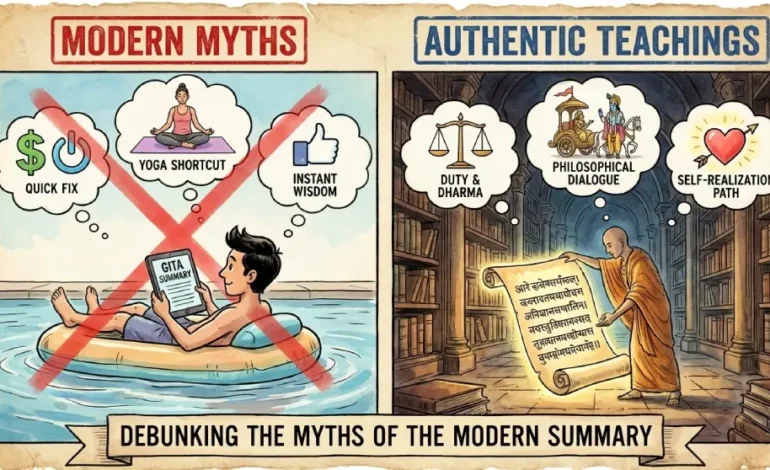
What the Bhagavad Gita Is NOT: Debunking the Myths of the Modern Summary

Reading Time: 5–6 Minutes
Introduction: The Noise of summaries
We live in an era of “Shorts,” “Reels,” and 60-second wisdom. If you scroll through social media, you will inevitably find hundreds of videos, articles, and influencers offering a “Summary of the Bhagavad Gita.”
From my childhood to the present day, I have watched people try to distill this immense cosmic dialogue into a few catchy slogans or a WhatsApp forward. However, whenever I discuss this text with people, I often feel a disconnect. They know the quotes, but they don’t know the context.
It is important to know what the Gita is, but perhaps it is even more critical to understand what the Bhagavad Gita is not.
The Gita is not a rulebook you can summarize on a sticky note. It is not a collection of motivational quotes. It is a surgical dissection of the human psyche. By reducing it to a few lines, we aren’t just simplifying it we are often completely misunderstanding it.
Myth 1: The “Karma” Trap (“Just Do Your Work”)
The most famous and most misunderstood line from the text is undoubtedly: “Karmanye vadhikaraste ma phaleshu kadachana” (You have a right to perform your prescribed duty, but you are not entitled to the fruits of action).
In popular culture, this has been translated to: “Karma kar, phal ki ichha mat kar” (Do the work, don’t desire the fruit).
Frankly, without understanding the base of this sentence, this advice seems incredibly stupid. If you tell a modern professional, “Just work, don’t think about the salary or the promotion,” they will laugh at you. How can a human being act without a motive? Every action has a goal.
The misconception here is the source of the action. People think the Gita is telling you to be a robot—to work blindly without caring about the outcome. This is wrong.
The Gita is not telling you to suppress your desire for the fruit; it is asking you to elevate your consciousness. When you act from a place of “Ego” (I am the doer), you are naturally obsessed with the result (What will I get?). The anxiety of the result actually hampers your performance. However, when you act from “Higher Consciousness” when you realize your true nature the desperate need for the fruit disappears. You don’t force yourself to stop caring; the attachment drops away automatically because you realize you are just an instrument.
It is not about suppression; it is about transcendence.
Myth 2: The “Careless Captain” (Duty vs. Detachment)
To explain this better, let’s use a practical analogy.
Imagine you are the Captain of a Football Team. It is the World Cup Final. If you follow the popular, wrong interpretation of the Gita, you might say: “Well, Krishna said don’t worry about the result. So, who cares if the ball goes into the goal or not? Let the opponent score. I am just doing my karma of running around the field.”
If a captain thinks like this, he is not a Yogi; he is a failure.
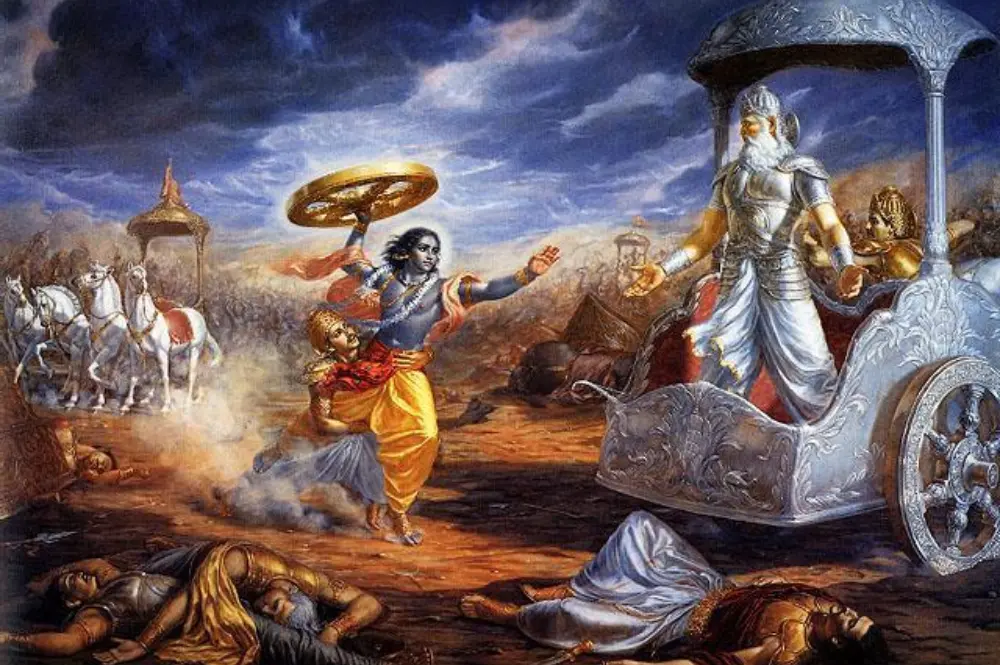
Krishna clearly tells Arjuna: “If you do not fight this righteous war, you will incur sin.” He does not tell Arjuna to drop his bow and sit in meditation. He tells him to stand up and fight with everything he has.
If you are a football captain, your Svadharma (Duty) is to win the match. Your focus must be on the goal. You must strategize, sweat, and sprint to put that ball in the net.
- The External Reality: You play to win. You play with fire and passion.
- The Internal Reality: You understand that this is just a match.
This is the nuance people miss. The Gita teaches that while you are playing, you play with your full heart. But deep down, you know that winning or losing this match does not define your existence. You play because it is your role in the universe at that moment.
If you win, you don’t let it go to your head. If you lose, you don’t let it break your heart. You play because the game is meant to be played, not because the trophy validates your worth as a human being.
Myth 3: The Book of “Superpowers”
There is a strange belief that reading the Bhagavad Gita will give you some mystical spiritual “superpower” or that it is a magic book that will solve your problems overnight.
The Bhagavad Gita is not a book where you get superpowers. In fact, it is the opposite. It is a book that strips you of your delusions.
The universe, according to the Gita, is not a place where you “manifest” things by magic. It is a complex interplay of the Three Gunas (Qualities of Nature):
- Sattva (Purity, harmony, light)
- Rajas (Passion, activity, movement)
- Tamas (Inertia, darkness, stagnation)
Everything you see around you your mood, your success, your failures, the economy, the weather is just a dance of these three Gunas. When you read the Gita, you don’t get the power to control the universe. You get the power to understand it.
You realize that “I am not the doer.” You realize that the anger you feel is just Rajas rising. The laziness you feel is just Tamas taking over. The clarity you feel is Sattva. You stop fighting the universe and start observing it.
The Concept of “Lila” (The Cosmic Play)
This brings us to the most beautiful realization the Gita offers: The Play.
The universe is a giant stage. We are all actors.
- A bad actor thinks the play is real. If his character dies on stage, he gets traumatized in real life.
- A good actor knows it is a play. He cries real tears on stage, he screams with real passion, but the moment the curtain falls, he wipes his face and goes home peacefully.
The Gita wants you to be the Good Actor. It doesn’t want you to leave the stage (run away to the Himalayas). It doesn’t want you to stop acting (stop working). It wants you to play your role whether it is an engineer, a father, a soldier, or a leader to perfection.
But it wants you to play “knowingly.” It wants you to remember that the character is not You.
Conclusion: Beyond the Quotes
We need to stop reducing the Bhagavad Gita to a self-help pamphlet. It is not about “Positive Thinking” or “Stress Management” those are just side effects.
It is a text about Identity. It challenges you to ask: Who is the one playing the football match? Is it the body? Is it the mind? Or is it something else?
So, the next time someone tells you, “Just do your karma and forget the result,” correct them. Tell them that the Gita is not about becoming careless. It is about becoming so painfully aware of the reality of the universe that the result no longer frightens you.
Don’t look for a summary. Look for the substance.