7 Tools of Civil Engineering: From Measurement to Global Impact

Civil engineering is often described as the “art of directing the great sources of power in nature for the use and convenience of man.” While textbooks will tell you that a civil engineer needs a calculator and a total station, the true toolkit of a successful engineer is far more profound. It is a blend of precision, foresight, resilience, and a touch of nomadic spirit.
Based on the foundational pillars of the craft, here are the seven essential tools every civil engineer must carry in their mental and physical arsenal.
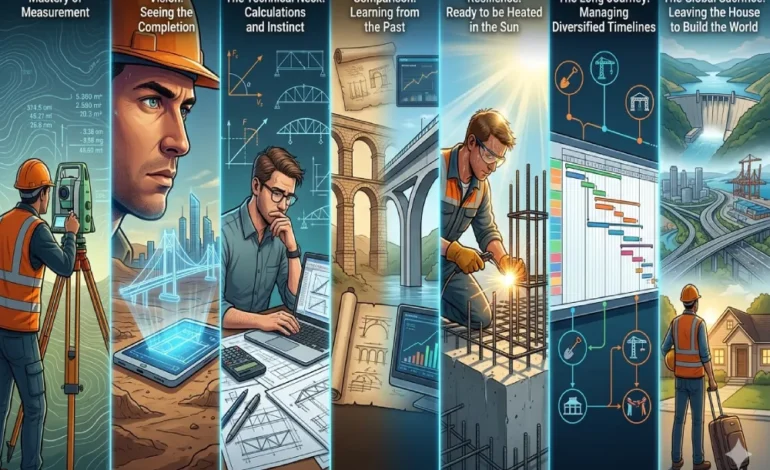
1. The Mastery of Measurement
In civil engineering, there is no room for “approximately.” Your notes highlight Measurement as the first tool, and for good reason. Whether it is the load-bearing capacity of a soil sample or the precise coordinates of a skyscraper’s foundation, measurement is the language of safety.
A millimeter’s error at the base of a structure can translate into meters of deviation at the summit. Beyond the physical tape measure or laser scanner, this tool represents the Analytical Mindset. It is the ability to quantify risk, calculate stress vectors, and ensure that every material used meets the exact specifications required for longevity.
2. Vision: Seeing the Completion
The second tool is Vision (Completion of Project). A civil engineer is a time traveller of sorts. They must look at a muddy, empty lot and see a finished bridge, a bustling highway, or a sustainable housing complex.
This “vision” isn’t just about aesthetics; it’s about Project Lifecycle Management. You must anticipate how the structure will interact with its environment twenty years down the line. Will the drainage hold during a hundred-year flood? Will the concrete withstand the local humidity? Vision allows an engineer to work backward from a successful conclusion, ensuring every step taken today leads to that final, standing structure.
3. The Technical Neck: Calculations and Instinct
Have a Technical Neck means thinking in terms of engineering mind. Looking in terms of calculative mindset with reference to specific work.
For eg you want to prepare a formwork for slab. Now there are scaffold, ledgers, square tubes, battens, wooden patti etc. Now for calculating a slab shutter at a particular level,you have to think that all the things mentioned must be fitted properly or whether it will be suited before starting of the work or any adjustment to be made and whether it will tech the load of so and so amount ?
4. Comparison: Learning from the Past
Comparison of Similar Projects before Execution is a vital tool for risk mitigation. No project exists in a vacuum. By studying similar builds—both their successes and their spectacular failures—an engineer gains “borrowed experience.”
Before breaking ground, a smart engineer asks:
- How did a similar soil type behave in a nearby city?
- What procurement issues did the last bridge project face?
- How can we improve upon the efficiency of the previous design?
- How is the colours , textures , tiles etc .behaves after few years ?
Comparison is the tool that prevents us from reinventing the wheel and, more importantly, from repeating the same mistakes.
5. Resilience: Ready to be Heated in the Sun
The fifth tool is perhaps the most visceral: The Readiness to be Heated in the Sun. Civil engineering is not a desk job. It is a field-based reality.
To build the world, you must be in the world. This means enduring 40°C or 50°C + heat on a slab pour, navigating mud during monsoon inspections, and standing on-site until the last truck leaves. This tool represents Physical and Mental Resilience. The site is a chaotic environment; being “ready for the sun” means you are prepared to lead from the front, regardless of the conditions.
6. The Long Journey: Managing Diversified Timelines
Civil engineering projects are rarely “quick wins.” As your notes suggest, it is a Long-term Journey involving Diversified Projects that take years to complete.
Unlike software updates that happen overnight, a dam or a subway system might take a decade from conception to commissioning. This tool is Patience and Persistence. An engineer must maintain the same level of quality and enthusiasm in year five as they did on day one. It requires managing a “diversified” set of stakeholders—government officials, local communities, and labourers—over a long horizon.
7. The Global Sacrifice: Leaving the House to Build the World
The final tool is a philosophical one: Leave the House to Build the World.
Civil engineers are the modern nomads. Often, the places that need infrastructure the most are the places furthest from home. Whether it’s a remote mountain pass or a developing coastal city, the engineer must be willing to go where the work is. This tool represents Purpose. It is the recognition that your contribution to society—the roads, the clean water systems, the power grids—is a legacy that far outweighs the personal sacrifice of travel. You leave your house so that millions of others can have a safe house of their own.
Summary Table: The Engineer’s Toolkit
| Tool | Core Function | Objective |
| Measurement | Precision & Data | Accuracy and Safety |
| Vision | Long-term Planning | Successful Project Delivery |
| Technical Neck | Calculation & imagination | Structural Integrity / Advance thinking |
| Comparison | Case Study Analysis | Risk Mitigation |
| Resilience | Field Presence | On-site Leadership |
| Persistence | Timeline Management | Sustaining Long Projects |
| Purpose | Global Contribution | Infrastructure Legacy |
Conclusion
Civil engineering is a demanding, gruelling, and deeply rewarding vocation. It requires more than just a degree; it requires a specific set of “tools” that define your character. By mastering measurement, maintaining vision, and embracing the sun and the long journey, you don’t just build structures—you build the foundation of civilization.